

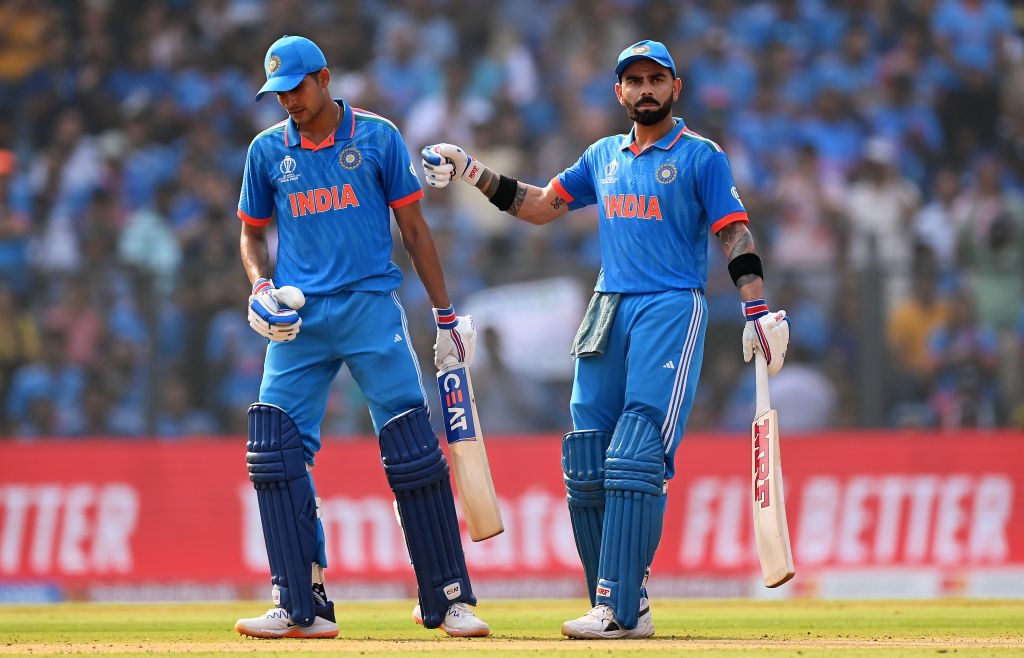
Virat Kohli and Shubman Gill are two of India’s finest batting talents, both having made significant impacts in ODI cricket. While Kohli went on to become one of the greatest batsmen of the modern era, Gill’s performances in his initial years have drawn comparisons with some of the best in the game. A comparison of their performances after 50 ODI innings gives an interesting perspective on how the two players fared at similar stages of their careers.
After 50 ODI innings, Shubman Gill had amassed 2,587 runs at an outstanding average of 60.16 and a strike rate of 101.93. This is significantly higher than Virat Kohli’s record at the same stage, where he had scored 1,827 runs at an average of 45.67 and a strike rate of 83.04. Gill’s ability to maintain a high scoring rate while being consistent highlights his adaptability to modern ODI cricket, where aggressive batting is more prominent.
In terms of centuries and half-centuries, Gill had already scored seven hundreds and fifteen fifties in his first 50 innings, whereas Kohli had registered five centuries and twelve fifties during the same phase. This showcases Gill’s ability to convert starts into big scores more frequently than Kohli did early in his career. Moreover, Gill’s highest score during this period was an astonishing 208 against New Zealand, while Kohli’s best knock in his first 50 innings was 118.
Another interesting comparison is their boundary-hitting ability. Gill had already hit close to 300 fours and over 50 sixes in his first 50 innings, whereas Kohli had struck fewer boundaries, with a notable difference in six-hitting. This demonstrates Gill’s aggressive and expansive approach, which has become a hallmark of modern ODI batting. Kohli, on the other hand, was still developing his game at this stage and relied more on strike rotation and finding gaps.
While Gill’s early numbers are superior to Kohli’s in almost every aspect, it’s essential to consider the different eras they played in. Kohli made his debut in 2008, at a time when ODI cricket was still transitioning from a conservative approach to a more attacking style. In contrast, Gill started his international career in an era where high-scoring matches, flat pitches, and aggressive batting were more common. Additionally, the quality of opposition, conditions, and team dynamics also play a role in shaping a player’s initial performances.
Despite these differences, both players have displayed remarkable talent and temperament in their early years. Kohli used his early experiences to evolve into a modern-day great, becoming one of the highest run-scorers in ODI history. Gill, on the other hand, has already shown the potential to follow a similar path, with his elegant stroke play, composure, and ability to play match-winning knocks.
For more news updates, follow 12B Sports India Facebook .