

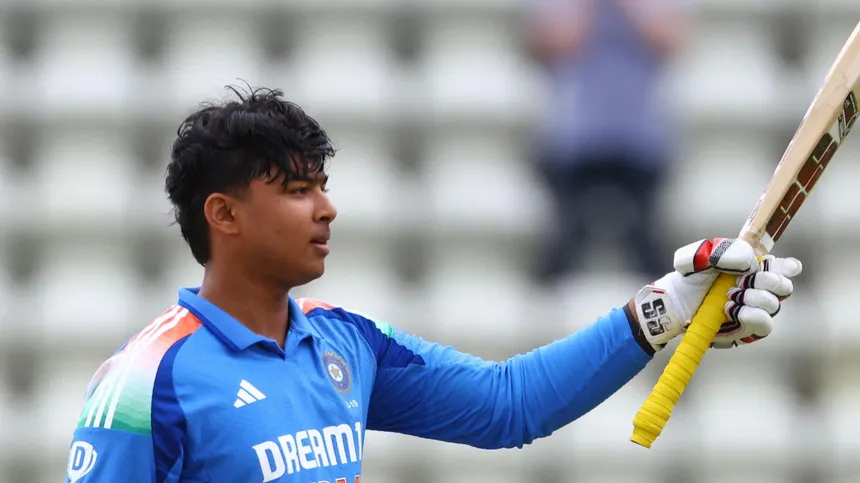
A thunderous on-field moment involving rising cricket star Vaibhav Suryavanshi has drawn widespread attention—not just for his explosive talent, but for the safety scare it caused. During a practice session, Suryavanshi unleashed a ferocious straight drive that struck dangerously close to a cameraman stationed down the ground. The force of the shot left the crew member visibly shaken, though thankfully unharmed. The incident has reignited debates about safety standards for field-level coverage in cricket.
The moment, caught on camera and quickly circulated across social media platforms, showed the ball screaming down the pitch with such velocity that the cameraman had no time to react. Those present gasped as the ball whizzed past, and Suryavanshi could be heard offering a stunned, sincere apology. Despite his young age, the batter’s sheer power has been turning heads across the domestic and junior circuits—and this incident only reinforced how dangerous such talent can be when safety protocols fall short.
Suryavanshi, still only a teenager, has been hailed as one of the brightest prospects in Indian cricket. With impressive performances in the U-19 setup and a growing presence in domestic leagues, his technical skills and fearlessness at the crease have already earned comparisons to seasoned power-hitters. But the recent scare has brought an important issue into the limelight: the vulnerability of those working behind the scenes.
This episode has sparked urgent discussion in media and cricket circles. With cricket balls traveling at speeds exceeding 140 km/h off the bat, camera crews and ground staff are often dangerously exposed, especially during live matches or intense net sessions. While batters typically wear protective gear, crew members often operate without helmets or barriers, relying only on reflexes and luck.
Experts are now calling for a review of on-field media safety regulations. Suggestions include enforcing minimum distance rules for camera positioning, mandating protective headgear for close-range operations, and educating crew members on player shot tendencies during practice. Some even advocate for the use of protective netting or glass shields in vulnerable areas.
Despite the scare, Suryavanshi’s maturity in the aftermath won praise. Rather than brushing off the incident, he acknowledged the risk and reportedly spoke with the crew member afterward to check on his well-being. It’s a small but significant gesture, highlighting the need for mutual respect between players and production teams.
In a sport where raw aggression and precision often meet, incidents like this serve as a powerful reminder: the spectacle of cricket must not come at the expense of safety. As the game evolves and players continue to push the boundaries of athletic performance, the infrastructure around them—especially for support staff—must evolve too.
For now, the cameraman is safe, and Suryavanshi continues his climb. But going forward, cricket authorities would do well to ensure that such moments become a cautionary tale, not a recurring headline.