

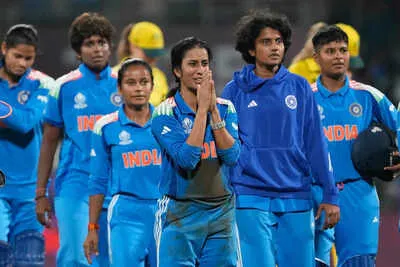
In a semifinal for the ages at the 2025 Women’s Cricket World Cup, India pulled off a stunning five-wicket victory over Australia by chasing down a mammoth 339, rewriting history in the process. At the heart of that chase were three key elements: anchoring the innings, accelerating when needed, and sheer mental nerve under pressure.
The anchor of the chase was Jemimah Rodrigues, who produced a career-defining unbeaten 127 from 134 balls. That knock wasn’t just about big shots — it was about composure, timing and resilience. India had stumbled early with the wicket of Smriti Mandhana, and the required run rate nudged upward into serious territory. Rodrigues, however, steadily built her innings. She rotated strike when necessary, punished loose deliveries, and ensured India didn’t lose momentum. Her unbeaten century became the backbone that held the chase together.
Parallel to Rodrigues’ anchor role was the need for acceleration. Enter Harmanpreet Kaur, whose 89 laid the critical platform that allowed India to push ahead when the match could easily have slipped away. Alongside Rodrigues she compiled the pivotal 167-run partnership that flipped the momentum. When Australia’s bowlers threatened with pressure and wickets, the two batters shifted gears at the right time — hitting boundaries, exploiting loose deliveries and keeping the required rate in check. That shift from consolidation to aggression separated this chase from a typical safe finish.
The third ingredient was nerve — the mental toughness required when every over feels like a final, and the target is never far from record-breaking levels. Australia had posted 338, fueled by a century and multiple half-centuries, and the Indian side knew their margin for error was small. Yet through moments of doubt, fielding lapses by Australia (including multiple drops of Rodrigues) and the looming pressure of the highest chase in women’s ODI history, India held their nerve. With nine balls to spare they sealed the win — a testament not just to skill but to belief.
This was more than just a big win — it was a statement. India’s top order may have shaken early, but the middle-overs recovery showcased maturity. Rodrigues’ anchoring allowed Kaur to play more expansively. The acceleration phase kept Australia’s bowlers guessing. And the nerve held firm when the fielding slipped, the crowd roared, and expectations mounted. The chase was methodical yet bold, structured yet daring — all in a single innings.
In sum: India’s chase was constructed on three pillars. The anchor role of Rodrigues provided stability; Kaur’s acceleration turned the tide; and the collective nerve under pressure made the difference. This wasn’t simply winning a semi-final — it was defining how modern women’s limited-overs cricket can be played: smart, fearless and historic.
12BET Shortlisted for Sportsbook Operator of the Year at SBC Awards 2025