

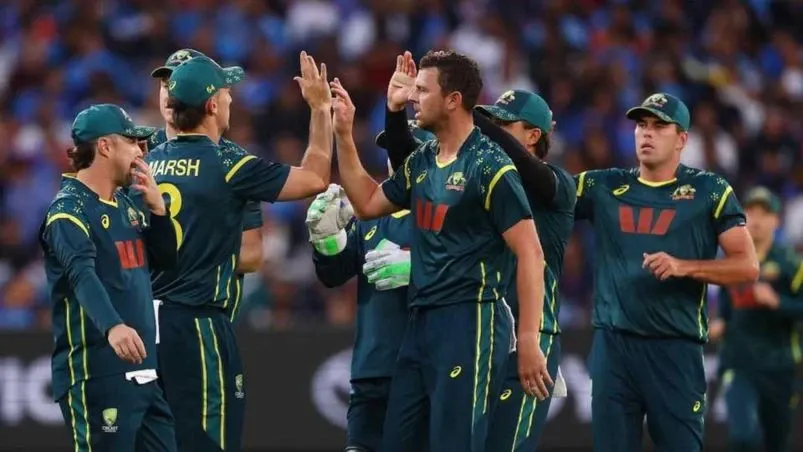
In the second T20I of the five-match series at the Melbourne Cricket Ground, the Australia men’s national cricket team defeated the India men’s national cricket team by four wickets to take a 1-0 lead, having effectively used the opportunity after the first game was abandoned.
India batted first and were sent back for just 125 in 18.4 overs. The innings was a tale of early damage and brief resistance. India lost both openers cheaply before young batter Abhishek Sharma stood out with a fighting 68 off 37 balls, injecting hope into a collapsing innings. He did all he could, but the rest of the batting line-up failed to contribute meaningfully. Australia’s pace spearhead Josh Hazlewood was instrumental, taking 3 for 13 and setting the tone early with incisive new-ball bowling that toppled the Indian top order. The visitors never recovered from their early loss of momentum.
In response, Australia made short work of the chase. Opting to go after the target from the start, their captain Mitchell Marsh led from the front with a blistering 46 off just 26 balls, including multiple sixes that crushed any lingering pressure. His opening partnership laid the platform, and once the target was established as achievable, Australia wrapped up the chase in just 13.2 overs — comfortably inside the powerplay overs of many T20s.
What stood out was the complete dominance of Australia across departments. With the ball, they struck early and often. With the bat, they never looked fazed. India, by contrast, looked brittle at times — the collapse under Hazlewood, plus the inability to back Abhishek’s knock with substantial support, proved costly. Fielding lapses and missed chances didn’t help either.
For India, the performance raises alarm bells ahead of the next games. Despite flashes of promise — particularly from young Abhishek Sharma — the failures of the majority of the batting line-up in these conditions highlight how tightly margined these contests are. On such a stage, even a modest total needs every batter to contribute; today they didn’t.
For Australia, the victory is confidence-boosting. They didn’t just win; they dominated. In a series where momentum and morale will count as much as skill, taking the lead and doing so with such authority places them in a strong position. The manner of the win suggests that their planning, execution and mental readiness are all sharp.
With the series now India needing to bounce back rather than Australia needing to press on, the psychological complexion has subtly shifted. India must regroup quickly, especially the batting, while Australia can approach the next match with calm assurance.
In summary: Australia’s four-wicket win is convincing, timely and strategically valuable. It underlines the weakness in India’s batting, the strength in Australia’s all-round display, and sets the tone for the series. If India are to turn the tide, immediate improvements are essential.
12BET Shortlisted for Sportsbook Operator of the Year at SBC Awards 2025