

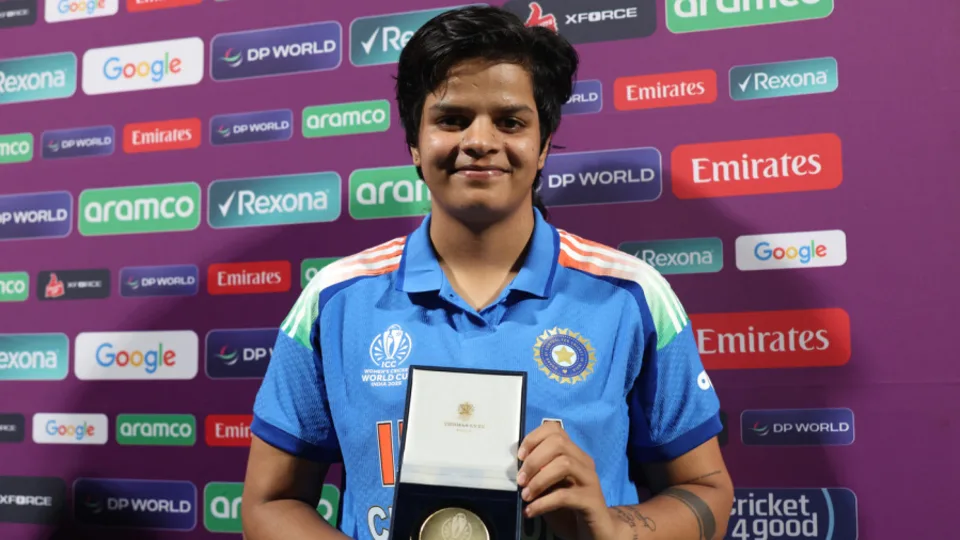
Shafali Verma and her Final of a lifetime as she had a game for the ages en route to winning player of the match.
The night Shafali Verma defied her destiny, and then owned it.
The sports field is one location where fate crafts its most dramatic scripts. For Shafali Verma, the narrative took place on one of the most significant days in Indian cricket history.
The tournament was not meant to be Shafali’s. She didn’t even make the reserves, never alone the 15-person World Cup team. Her absence from the squad sparked questions because she is a player whose name has been associated with bold strokeplay.
However, fate had other ideas for her on Sunday in Navi Mumbai. Shafali had taken control of the competition. She won Player-of-the-Match and cemented her position in World Cup history by finishing as India’s top scorer in the final and, astonishingly, taking two wickets—the same Shafali who had bowled just six times in her 31-match ODI career.
Shafali had returned to local cricket after being dropped out of the white-ball squads the previous year, looking for the rhythm that had previously made her India’s most formidable opener. She battled her way back into the T20I team, but not the ODIs. The bittersweet turn came next.
Pratika Rawal’s return to the ODI squad was made possible by an unfortunate injury. It happened just before the World Cup semifinal. “I firmly believe that everything is predetermined. At the news conference following the final, Harmanpreet Kaur stated, “We didn’t want her to feel that she [Shafali] came in under an injury cloud.” Shafali had little effect during the semi-final, but she made a comeback on Sunday.
Shafali was clearly herself when she went out to bat: she jogged quickly to the crease, glanced around the field, adjusted her helmet slightly and had that signature swagger. South Africa’s fielders ran to the rope as the opening few strokes, which came down the track to slice, drive, and flick boundaries, carried authority and intent. She walked down to Smriti Mandhana after a clean cover drive, shaking her head and grinning as if to say “we’ve got this.”
She didn’t hit a boundary for twenty balls during that time. But would it be possible to keep Shafali under control for very long? She had never been very good at waiting and observing.
Shafali moved down the pitch and hoisted Nadine de Klerk clean back over the head for six as she came back to bowl. She went down the pitch with her eyes tracking the ball’s direction while maintaining the pose, which was a picture of bold control. For her, the Navi Mumbai crowd yelled twice as loudly as everyone else that evening. Perhaps many had just heard stories about her audacity; now they were witnessing it firsthand.
Then the unexpected turn of events occurred. Harmanpreet sent the ball to Shafali in the twenty-first over of South Africa’s chase, when Laura Wolvaardt was in full swing and Sune Luus was establishing rhythm. India’s spinners had laboured in vain. However, as Harmanpreet subsequently disclosed, the risk wasn’t merely instinctive; rather, it was a component of a strategy.
In domestic cricket, Shafali had been bowling frequently. She ended as the leading run scorer in both the recent domestic T20 Trophy and the 2024–25 Senior Women’s One-Day Trophy, where she took eight wickets in seven games. However, this was the World Cup final.
Her first delivery was a dart at 95 kph, followed by a tempting offbreak at 81 kph. Despite his best efforts, Luus ended up chipping it straight back. Even before the ball landed in her hands, Shafali was grinning. Chants of “Sha-fa-li, Sha-fa-li” quickly filled the stadium as it erupted.
She delivered one that spun back into Marizanne Kapp on her subsequent over, and Kapp edged to the keeper. The breakthrough turned the tide in India’s favour; the team surged, the fans erupted, and Shafali was once again in the centre of it all, enjoying the moment.
There was no script for that night. A knock that won the match, a spell that changed the course of the game, and a Player-of-the-Final performance in a tournament she wasn’t even supposed to compete in. What is destiny if that isn’t it?
Her call-up for the World Cup was unplanned. Her final performance wasn’t prearranged. She wasn’t even considered for India’s crown. However, she was more than just a late replacement who performed admirably. She was called upon when the team most needed her, crowned on a night India would never forget, and in every way, she was destiny’s kid.