

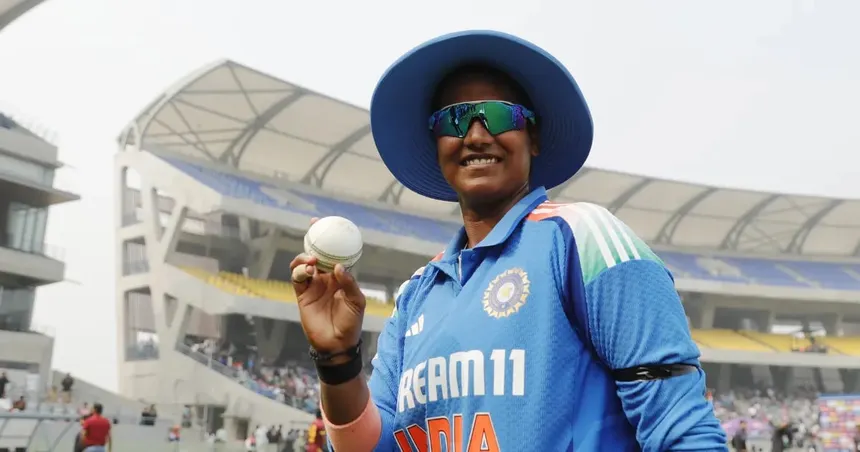
Deepti Sharma says that the recent triumph of the India women’s cricket team in the 2025 ICC Women’s Cricket World Cup has changed more than just her cricketing résumé — it has transformed her public life and, she believes, marked the beginning of a new era for women’s cricket in India. In her reflections, she also made a firm statement: “the day is not far when there will be pay parity in cricket.”
Sharma’s personal story is compelling. After producing a Player-of-the-Tournament performance — including 215 runs and 22 wickets — she says that “even with a mask on, people recognise me,” a sign of the sudden rise in visibility for women’s cricketers. Usually able to walk freely through malls and public spaces, she now experiences the dilemmas of fame: having to move with more caution, field more questions, and navigate a world that has taken notice. She describes the transformation as both surreal and humbling — proof that the sport’s identity in India is shifting.
But for Sharma, it’s not just about being seen. The win, she says, has raised the bar for what Indian women cricketers can expect in terms of institutional support, media attention and public perception. She recalled how the defeat of the past — tournament losses, limited exposure, fewer matches — has given way to a sense of accomplishment and possibility. She told interviewers that this victory “is our 1983 moment”, referring to how the men’s team’s 1983 World Cup win changed Indian cricket forever. She confidently expects comparable change for the women’s game.
Central to that change is the question of remuneration. Sharma declared that India’s women’s cricketers will soon see genuine pay parity. While professionalisation and fixture-expansion have improved gradually, she stated that transforming pay structures remains important: “We already have the pay parity now,” she noted, “and the day isn’t far when we’ll see real parity.” Her phrasing suggests both optimism and a challenge: the promise is near, but it still requires follow-through.
The significance of this comment is heightened by the context of the sport. For years, India’s female cricketers faced unequal contracts, fewer matches, and limited commercial opportunity. The World Cup win has shifted those conditions — sponsorships, fan interest, and media coverage have all surged. Sharma’s visibility, her public journey from Agra to global glory, and her message about equality all reinforce that the sport’s infrastructure is being encouraged to catch up.
Sharma also reflected on how the rise in conditions — more televised games, better pay-per-match, a stronger domestic-to-international pipeline — make the sport more accessible to young girls. She said that when future players see “us lifting the trophy,” the shift in mindset will spread: from “I want to play sport” to “I want to play cricket.” The ripple effect of her team’s success, she believes, will be felt for years in academies, smaller towns, and communities across India.
She is under no illusion that the hard work ends here. For her, the real momentum begins now. She acknowledged that public recognition is nice, but what matters most is performance, consistency and continued improvement. Her leadership — as a world-class all-rounder and public ambassador — aligns with a broader ambition: to use this moment as a springboard for structural and cultural change in women’s cricket.
12BET Shortlisted for Sportsbook Operator of the Year at SBC Awards 2025