

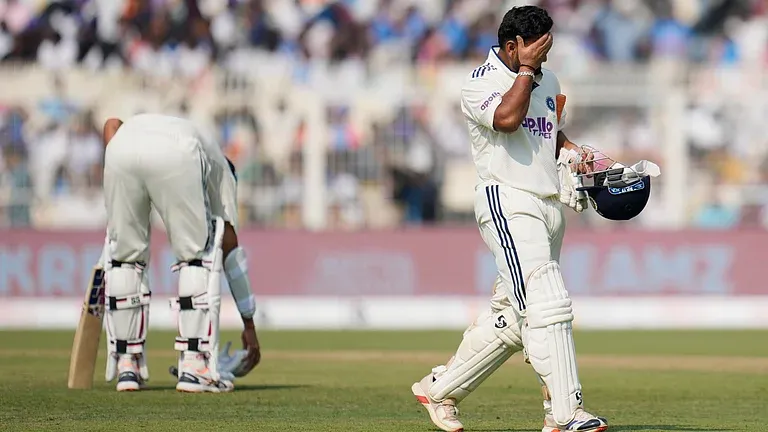
What unfolded in Guwahati wasn’t a Test innings. It was a white-ball hangover colliding with red-ball demands, exposed on live television. Commentators, analysts, and former players have been tearing into India’s batting collapse from Day 3 of the second Test, and the consensus is brutally clear: this wasn’t a session lost to brilliance — it was gifted through flawed technique, brain-dead shot-selection, and vanishing partnerships.
India entered the match at Barsapara Cricket Stadium carrying first-innings pressure after South Africa national cricket team had already piled up 489. With leverage established, the visitors didn’t bother with tricks. They bowled fast, hard, high — and waited for India to implode. And implode they did: from 95 for 1, India cratered to 122 for 7, losing six wickets for 27 runs. That passage of play wasn’t unlucky. It was predictable.
The loudest truth came from Anil Kumble, who slammed India for looking unprepared and tactically clueless, implying that application and patience were absent by design, not circumstance. Batters weren’t playing late, weren’t trusting the forward defence, and couldn’t decide whether to leave or flirt with balls that bounced like trampoline rejects. Front-foot movement, decisive head position, and late play — the basic grammar of Test batting — were missing across entire brackets of the order.
Adding equal venom, Ravi Shastri labelled the batting display “very ordinary,” arguing that India’s middle order made dismissals look soft because they were soft. Cross-bat heaves against rising length balls, chasing glory over survival, and playing in the air when the brief demanded playing on the ground — it wasn’t aggression. It was a misunderstanding of format. Bluntly, this was T20 instinct cosplaying Test intent.
Even the lower-order fight had limits. When Yashasvi Jaiswal scored 58 and Washington Sundar made 48, it looked briefly like a rebuild. But rebuilds require support, symmetry, and repeatability. These knocks were islands, not bridges. Once both departed, India’s lineup didn’t fold, it evaporated — no middle-order glue, no absorbing pressure in hour blocks, no passing the baton within partnerships.
Critics are also dragging selection policy into the blast furnace. The batting unit has become a carousel because India keep picking for “balance” over best specialists. Too many all-rounders, too many reshuffles, too few settled top-five constants. The pitch demanded hardened red-ball technique and clarity in roles. The team sheet delivered musical chairs.
Technically, the flaws were a perfect storm. Feet frozen at the crease instead of covering the line. Heads falling outside the eyeline of release points. Hands hardening early instead of softening late. And the biggest crime: shot choices that leaked momentary intent but murdered long-form viability. The surface with bounce wasn’t the villain; it was the examiner. India failed the exam before lunch was over.
Looking forward, this isn’t a one-off talking point, it’s a fork in the road. Subcontinent surfaces are evolving—steeper, faster, with more pronounced bounce windows. India must evolve batting psychology that accepts controlled defence, late strike rotation, and serious bruise tolerance as prerequisites for modern Test cricket at home. Recovery must start by picking a stable specialist batting spine, coaching late play and decisive footwork into muscle memory, and rewriting the cultural expectation that scoring first is always the correct response to pressure. Sometimes, survival is scoring, because it buys time and bleeds leverage from opponents instead of gifting it.
As for South Africa, they’re not just playing a Test, they’re pushing a narrative: you can win big in Asia by pace, stamina, and discipline if the home side forget to bat like their ground conditions have changed. India now trail by roughly 314 after being bowled out for 201. The question left isn’t how they recover in this match, but how fast they snap out of denial for the next one.
India’s middle order didn’t lose partnerships. They refused to build any. The scrutiny is deserved. The fix needs to be faster than the criticism cycle, or this era will be remembered exactly for what it is threatening to become — talented, popular, chaotic, and strategically outdated at the batting crease.
12BET Shortlisted for Sportsbook Operator of the Year at SBC Awards 2025