

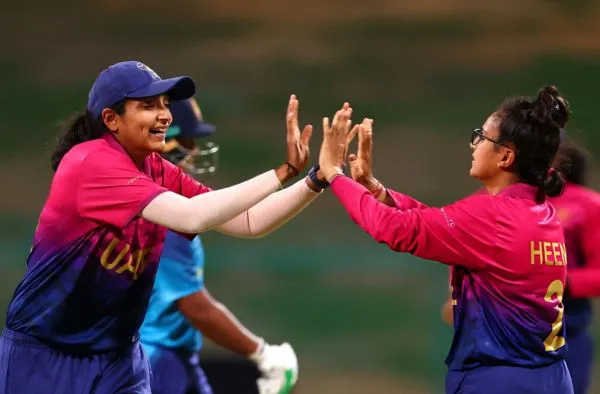
The UAE Women delivered a pressure-soaked performance to beat Thailand Women by 7 runs in a tense ICC Women’s Emerging Nations Trophy contest in Bangkok. On paper the game looked like a low-scoring scrap, but low totals don’t make low drama. They exposed every little weakness — and every ounce of composure.
Batting first, the UAE Women never settled into a rhythm. Thailand Women, led by their disciplined spinners and an aggressive fielding setup, kept squeezing the innings from the opening over. Powerplay overs that should have brought tempo brought nerve instead. Balls were ripped off good lengths, the rotation stalled, and pressure wickets kept landing at the worst possible times. The innings became less about intent and more about survival, but survival still produced very little. The scoreboard crawled instead of climbed. Dot balls piled up like unpaid invoices. Attempts to break the shackles too often found fielders rather than gaps. Partnerships that needed to grow roots grew doubts. It was an innings without a spine, a plan without an anchor, and a total that felt impossibly thin. The UAE Women were eventually bowled out for 80 — all 10 wickets gone inside 20 overs — a reflection of Thailand’s tactical squeeze, but also of UAE’s lack of execution with the bat.
Any total of 80 in T20 is precarious. Any defence of 80 against a good associate side requires more than skill: it requires belief. And belief is precisely what UAE’s bowling delivered. Thailand Women began their chase with early promise. Suwanan Khiaoto pushed 24 off 24 balls, an innings packed with smart strike rotation and intent that briefly suggested the chase was there for the hosts’ taking. But brief suggestions don’t win matches; sustained execution does. Khiaoto’s wicket signaled the beginning of gradually tightening screws. UAE’s bowlers kept dragging the game into the deep. They bowled like the target was 73 but played like the target was 173.
The trump card was Vaishnave Mahesh whose 4/10 spell across four overs changed the gravitational field of the game. Mahesh didn’t rely on mystery. She relied on repetition: length, turn if available, and unwavering control. Her overs were economy clinics disguised as wicket-hauls. She attacked without leaking. The pitch offered predictable bounce and decent carry, enough for batting competence, but Mahesh’s discipline made competence feel risky. Each wicket she took didn’t just reduce runs; it colonized doubts. Thailand’s middle order found themselves battling rising required rates and rising uncertainty simultaneously. The chase became a mental math problem Bangladesh’s batters know well: how do you accelerate when you don’t trust the length you’re facing, the field you’re working with, or the score you’re trying to pull back? Thailand Women had no consistent partnership to stabilize the chase after Mahesh’s breakthroughs.
The collapse wasn’t an avalanche. It was erosion. The UAE Women never gave Thailand a window large enough for confidence. UAE’s supporting pace bowlers kept hitting lengths that forced either high-risk aggression or stalled defence. Boundaries became scarce. Singles became harder. Wickets kept falling at a cadence designed to bruise planning. At 73, Thailand were bowled out in 19.3 overs, leaving UAE to breathe relief but earn respect.
This match matters in the larger arc of women’s cricket among associate nations. The ICC has made tournaments like these platforms for development, exposure, and pressure literacy. The test of associate cricket isn’t simply talent pools; it’s pressure pools. Games like this don’t offer glamour totals — they offer mental auditions. UAE’s defence was more than skillful; it was strategic stubbornness. Mahesh’s spell reifies a larger trend: associate-nation cricket has graduated from chaotic scrappiness to disciplined micro-margin contests where execution and temperament rewrite narratives.
For Thailand Women, the loss underscores a clear forward step: they can orchestrate pressure, but must build better chase depth and partnership resilience to close tight games. For UAE Women, the victory proves that home dominance in associate arenas isn’t scripted by totals — it’s written by composure, planning clarity, and bowlers who refuse to blink at modest scores.
Cricket’s future includes more of this: not long sedated draws, but fast, furious, pressure-literate contests where each ball carries consequence. UAE Women understood that script better on the day, and they earned the 7-run separation through discipline, not luck.
12BET Shortlisted for Sportsbook Operator of the Year at SBC Awards 2025