

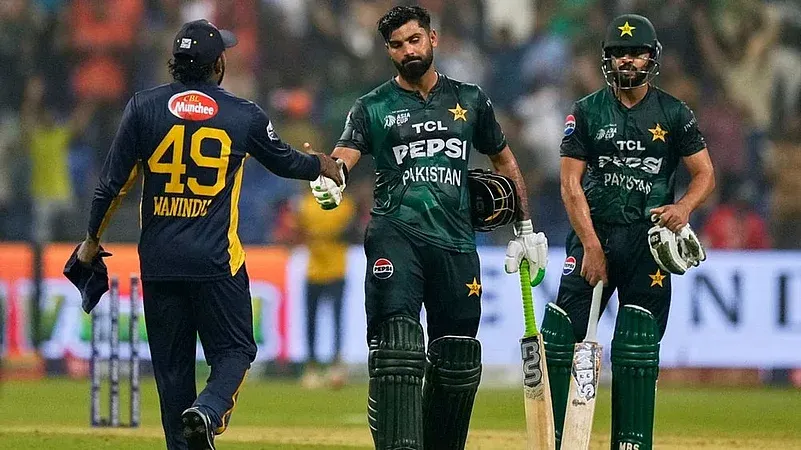
Pakistan national cricket team delivered a clinical finish to their 2025 T20I Tri-Nation Series campaign, cruising past Sri Lanka national cricket team in Rawalpindi on the back of a spellbinding performance from Mohammad Nawaz. In a final that became a showcase of spin dominance, Nawaz’s 3/17 display earned him Player of the Match honours and set the tone for Pakistan’s controlled run-chase to secure the title.
The match narrative flipped on its head at the 10-over mark. Sri Lanka opted to bat first and exploded out of the gates, powered by Kamil Mishara’s calculated aggression. The young opener carried the innings initially, racing to 59 off 41 — a knock built with sharp placement, nimble running, and the occasional aerial strike when Arshad Iqbal missed his lengths. For a moment, Sri Lanka looked capable of posting a competitive total despite a tacky surface that began to grip and turn as the evening wore on.
Then Pakistan introduced spin, and everything changed. Mohammad Nawaz, representing Pakistan’s renewed trust in adaptable all-rounders, struck almost immediately. His first major blow was Kusal Mendis, who had just begun to pivot from stabiliser to accelerator. Nawaz slid one across the right-hander, drawing Mendis into a loft that held up in the slowing air — caught safely in the ring by Saim Ayub. The very next over revealed tactical intent: pushing Janith Liyanage back with a fuller ball that spun just enough, forcing a premeditated inside-out that found deep square leg’s hands instead of the boundary.
By now, the cracks in Sri Lanka’s blueprint were impossible to hide. Pressure births poor decisions, and Pakistan exploited every beat of hesitation. Nawaz’s third scalp, Wanindu Hasaranga — Sri Lanka’s most reliable chaos-merchant — was crucial. Nawaz baited him with flight, dropped the pace fractionally, and watched Hasaranga slog across the line too early. The stumps lit up under Shaheen Afridi’s approving stare. From 84/2 in the 10th over, Sri Lanka spiralled into a collapse of stunning proportions, losing 8 wickets for just 30 runs. The lower order unravelled without protest. None from positions 4 to 11 reached double digits; none hit a boundary after the implosion began. Deliveries that turned and deliveries that didn’t were met with equal confusion — a sign of a plan executed without contingency.
But Nawaz’s influence didn’t live in isolation. He found symmetry within the attack. Shadab Khan, as Pakistan’s spin X-factor and a key voice in mid-inning field placements, tightened the screws further from the Cat End, and Agha Salman induced edges and mis-hits as the pitch grew stiffer. Spin accounted for 6 of the 10 Sri Lankan wickets, underlining Pakistan’s decision to build a multi-dimensional bowling approach instead of leaning exclusively on raw pace. For Nawaz, the spell was a reminder that basic control can be lethal when paired with game-sense. He bowled a mix of seam-up sliders, subtle cutters, and conventional finger-spin — no circus tricks, just chess moves bowled at 119–124 kph with intent.
Pakistan’s chase was calm, bordering on inevitable. The 115-run target looked trickier on paper than it was after the mental damage of Sri Lanka’s batting second half. Openers Saim Ayub (36 off 25) and Sahibzada Farhan (23 off 18) walked in with a singular mandate: remove doubt early. They did exactly that, constructing a 46-run opening stand that negated the surface’s slowness by consistently nudging the score ahead of the required rate. Ayub danced when he needed to, Farhan punched gaps square when height wasn’t on offer. Once Babar Azam arrived, the finish line ceased to be a question and became a formality. His unbeaten 37 off 34 was everything a captain needs in a final: absorbing pressure, steering strike, piercing fields without forcing the pitch to be something it wasn’t, and closing out without spectator anxiety.
Nawaz fittingly collected Player of the Match recognition for his direct role in the collapse, while also claiming Player of the Series for a tournament built on repeat, condition-driven impact. For Pakistan, this was more than a trophy. It was validation that their T20 future must continue to prioritise flexible all-rounders, spin variety, and decision-calmness at crunch moments. The victory also marked Pakistan’s first multi-team tournament final win on home soil — a symbolic moment in their modern T20 arc.
12BET Shortlisted for Sportsbook Operator of the Year at SBC Awards 2025