

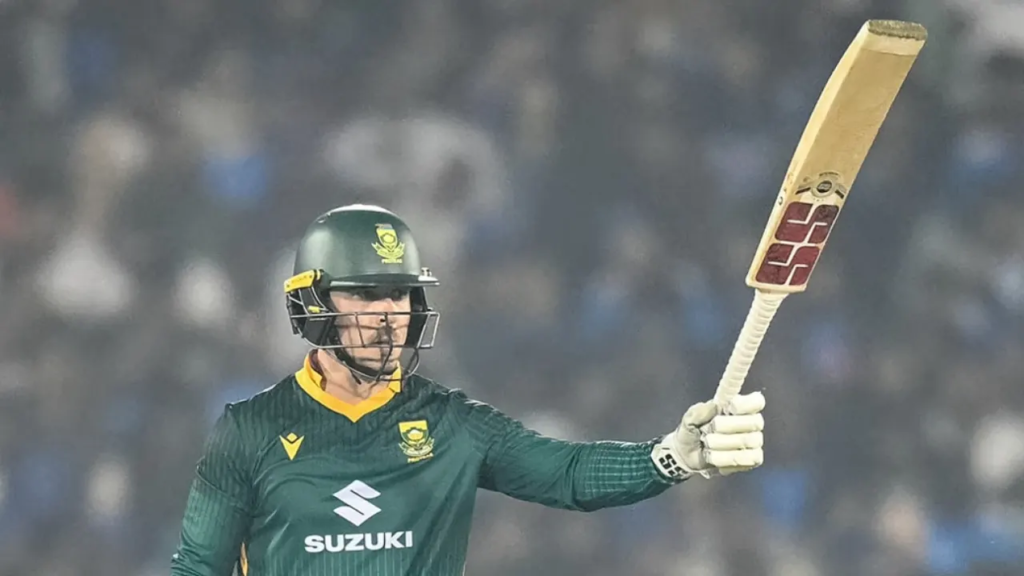
South Africa’s young guns have a lot to learn from Rohit and Kohli as coach Conrad hopes they ‘grow from there’.
Conrad hopes SA’s young guns learn from Kohli, Rohit and ‘grow from there’.
The excitement in Ranchi, Raipur and Visakhapatnam wasn’t limited to the home supporters eager to watch Virat Kohli and Rohit Sharma — South Africa’s emerging batters were just as keen observers.
For the likes of Ryan Rickelton, Matthew Breetzke and Dewald Brevis, all newcomers to ODIs against India, sharing the field with two of the most prolific run-makers in the game offered a rare learning opportunity. Coach Shukri Conrad believes that close-up exposure to the methods of Kohli and Rohit could shape their development. As he put it, seeing how the very best operate at the top level is a lesson he hopes his young players absorb and build upon in their own careers.
Virat Kohli dominated the series from start to finish, striking hundreds in the opening two matches and ending as the leading run-getter overall. Rohit Sharma complemented him with a pair of brisk, stylish half-centuries. Together, they were central to India repeatedly stacking up imposing totals. South Africa matched those heights on two occasions, but what set India apart was the relentless reliability of their senior stars — a standard that was as striking to watch as it was difficult to match.
For South Africa, Matthew Breetzke topped the scoring charts with two fifties, adding to an impressive early ODI record that already includes a century and five half-centuries from just 12 games. His high-energy approach has even drawn comparisons with Kohli from his SA20 skipper Keshav Maharaj. Yet, despite that promise, his overall output was barely half of Kohli’s for the series, underlining the gulf between the two line-ups.
There were isolated bright spots — centuries for Aiden Markram and Quinton de Kock, and fifties from Temba Bavuma and Dewald Brevis — but as a unit, South Africa failed to build consistently on their starts. Ryan Rickelton’s struggles, particularly in terms of movement at the crease, have become a concern, while uncertainty still hangs over the makeup of the top order. Matters have been compounded by Tony de Zorzi’s grade-three hamstring injury, which will sideline him for an extended period and disrupt South Africa’s short- and medium-term planning.
Fresh off the momentum of their strong Test performances the previous month, South Africa arrived determined to measure themselves against elite opposition — and for the most part, they pushed hard. In the opening match, they came up just 18 runs short while pursuing 350. In the next game, they successfully hunted down a daunting 359. But when it was their turn to set the agenda with the bat in the third fixture, they failed to put up a total that could truly challenge, and that proved costly. Conrad made it clear that he wasn’t leaning on that as an excuse.
Their campaign was further complicated by the absence of Kagiso Rabada from the start, followed by Nandre Burger being unavailable for the final match. As a result, they struggled both to stem the flow of runs and to strike with regularity. Marco Jansen’s four wickets across the series topped their bowling returns, a modest tally when set against Kuldeep Yadav’s nine. Even Keshav Maharaj, their lead spinner, managed only a single wicket from two appearances, though his economy rate of 5.70 was the tightest among South Africa’s bowlers.
“We had a chance to do something really special. I think the last time India lost both a Test and ODI series at home goes back to the 1990s,” Conrad said. “So we missed out on that opportunity. But they’re a world-class side with world-class players. And when Rohit’s in the type of form, and Virat, especially, is in the type of form that he’s in, you cannot afford to be off your game.”