

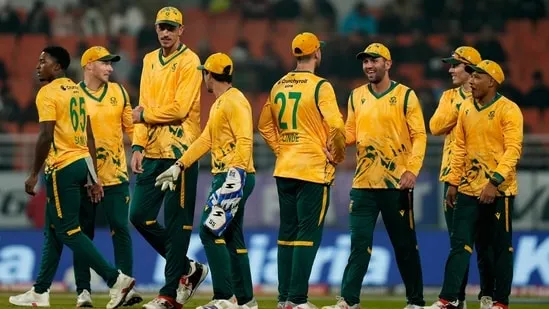
India’s chase in the second T20I against South Africa at New Chandigarh never truly got off the ground, largely due to early breakthroughs by the visitors that exposed vulnerabilities at the top of the order. Shubman Gill and Abhishek Sharma, both key contributors for India, fell cheaply, handing South Africa immediate control and setting the tone for a commanding 51-run victory.
The match began with India aiming to chase a challenging total of 214. Confidence from their previous encounter was tested immediately as South Africa’s bowlers executed their plans with precision. The new-ball attack targeted the stumps consistently, and disciplined lengths forced the Indian openers into uncomfortable positions. Shubman Gill, known for his composure against pace, failed to adjust to the early movement and misjudged a delivery that had just enough swing to find the edge. His dismissal in the first few overs left India reeling at a critical juncture.
Abhishek Sharma, walking in at number three, faced the unenviable task of stabilizing the innings under mounting pressure. Despite showing intent, he too fell cheaply, unable to negotiate a sharp delivery that penetrated the middle and off-stump line. By the time the third over concluded, India had lost two key wickets with minimal runs on the board — a scenario that immediately tilted the psychological balance in South Africa’s favor.
South Africa’s early dominance was not merely about taking wickets; it was also about controlling the flow of runs. Dot balls increased steadily, run-scoring options were limited, and the Indian batters found themselves squeezed by accurate lengths and subtle variations. The early fall of wickets amplified the pressure on the middle order, forcing them into riskier shots and making run accumulation an uphill task.
The early collapse also highlighted some technical weaknesses in India’s approach to powerplay bowling. The batters struggled to adapt to the pace and bounce on the wicket, and the timing of aggressive strokes was often off, leading to edges and mis-hits. South Africa’s bowlers exploited these vulnerabilities intelligently, ensuring that the innings never found rhythm.
While India’s middle order, including Tilak Varma and Hardik Pandya, tried to rebuild and add momentum, the early setbacks meant they were always playing catch-up. South Africa’s fielding support complemented the bowling plan perfectly — pressure was applied not just with the ball but also through sharp field placements, saving crucial singles and creating catching opportunities.
From a broader perspective, the top-order struggle has strategic implications for India. Losing early wickets against a disciplined pace attack can turn competitive totals into daunting challenges. Against a team like South Africa, who are adept at exploiting pressure, the margin for error is minimal. This match serves as a reminder of the importance of a steady start in T20 cricket, especially when chasing a large target.
In the end, South Africa’s early success, spearheaded by disciplined bowling and intelligent fielding, ensured that India’s chase never gained momentum. The failures of Shubman Gill and Abhishek Sharma were pivotal moments, giving the visitors control of both scoreboard and momentum and ultimately shaping the outcome of the second T20I.
12BET Shortlisted for Sportsbook Operator of the Year at SBC Awards 2025