

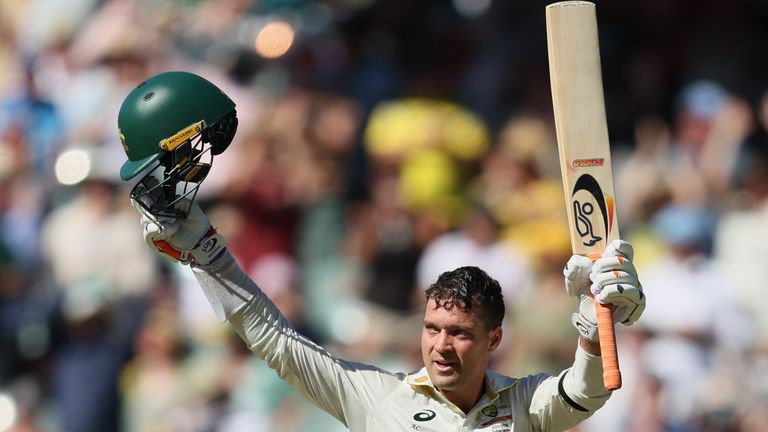
Carey century overshadows Australia’s chaotic batting at Adelaide as the Ashes refuses to find slower gear.
Carey century keeps Australia afloat as Ashes refuses to find slower gear.
Even after just seven days, this Ashes series is still not in the mood to slow down and observe its surroundings. In some ways, this first day at Adelaide Oval was just as crazy as the previous six. By the time it ended, a cricket-record 56,298 spectators had no idea if England was on the verge of winning this series or if Alex Carey’s outstanding first Ashes century had already put them on the verge of elimination.
The teams and spectators came together in a flawless tribute to the victims of the Bondi terror horror only minutes before the first ball was bowled, providing the only quiet moment of the day. On either side of that calm moment, chaos erupted, beginning with Steven Smith’s unexpected withdrawal 45 minutes prior to the toss due to vertigo, which gave Usman Khawaja a reprieve for this match as well as possibly his Test career.
On a hot morning in the field, England’s bowlers threatened to lose the plot with an opening gambit, but Australia returned the favour with a run of five consecutive guilty dismissals and six out of eight overall. The most damning of them were Jofra Archer’s two wickets in three balls right after noon, which sparked England’s comeback in a very personal reaction to the criticism he had received during the Brisbane defeat.
As if that weren’t enough, there was also room in the story for Khawaja’s career prospects to suddenly improve when Harry Brook’s slip on number five convinced him to let go of his shyness and enjoy a tonne of freebies from a laborious but very faulty assault. Another DRS controversy also emerged in the last session, with veteran ICC umpire Simon Taufel declaring Carey’s reprieve for a caught-behind on 72 to be another example of “technology calibration” gone wrong. At the end, Carey admitted that he believed he had heard a nick.
The result was yet another warp-speed Ashes day. The hard-line discipline and sporadic raw speed of Archer, whose 3 for 29 in 16 overs made him as much of a lone wolf in England’s attack as Mitchell Starc had been for Australia in each of his first innings at Perth and Brisbane, were solely responsible for Australia’s run-rate falling short of 4 an over.
And just as Starc’s dominance had caused England’s hitters to make nervous mistakes in those games, Australia was the team that squandered an opportunity to control this match and possibly the series.
After winning the toss and batting first at Adelaide, the hosts have only scored less than 439 once this century. That innings of 245 came during England’s historic victory on their victorious tour in 2010–11. It’s possible that he will be able to marshal the tail on the second morning, as he did successfully at the Gabba, as his adversary Starc is still in position at the close on 29 not out.
However, it should be up to England’s batsmen soon enough to see if they have learnt anything from their frivolity thus far, especially against a three-over-old ball and an England team that is currently displaying their “dog,” imperfect and wild though it may be.