

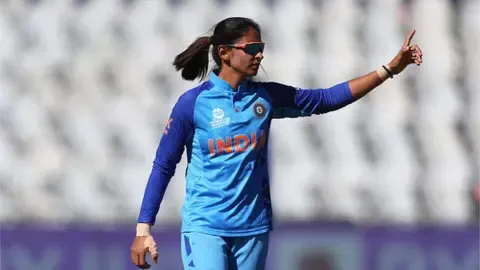
India Women put up a competitive 155 for 6 in the final T20I, driven by a determined 52 from Harmanpreet Kaur, but the total ultimately proved insufficient against a composed Australian chase. The innings reflected both promise and persistent issues that defined India’s campaign across the series — solid individual performances without the collective ruthlessness needed to dominate at the highest level.
India’s start was steady rather than explosive, with the top order focused on preserving wickets in the early overs. While this approach ensured stability, it also meant the run rate never truly surged during the powerplay. Boundaries were hard to come by against disciplined bowling, and India found themselves playing catch-up earlier than ideal. The loss of wickets at regular intervals prevented momentum from building, keeping the innings in a controlled but restrained state.
Harmanpreet Kaur emerged as the central figure once again when pressure mounted. Walking in with India needing direction, she played with authority and intent, blending experience with calculated aggression. Her half-century was built on strong game awareness — rotating the strike against tight overs and attacking decisively when bowlers missed their lengths. It was a captain’s knock in every sense, one that gave India a fighting chance on a night where margins mattered.
What made Harmanpreet’s innings significant was the timing of her acceleration. As the innings moved into its latter half, she began to take on the bowlers, targeting the shorter boundaries and using her strength down the ground. Her ability to absorb pressure and then flip it back onto the opposition briefly lifted India’s scoring rate and injected belief into the dugout.
However, support around her remained inconsistent. While there were small contributions from the middle order, no other batter stayed long enough to form a decisive partnership. As wickets fell, India were forced to recalibrate repeatedly, limiting their ability to fully exploit the death overs. The final push yielded useful runs but lacked the explosive finish that often separates defendable totals from chaseable ones in T20 cricket.
Australia’s bowling effort played a major role in keeping India to 155. Their attack mixed pace, length, and field placements effectively, denying India easy scoring options. Even in the final overs, they avoided panic, forcing India to earn nearly every run. That discipline ensured the total, while competitive, remained within reach.
From a broader perspective, India’s innings mirrored the story of their series. Leadership and individual class — especially from Harmanpreet — were evident, but the absence of sustained partnerships and all-out aggression at key moments continued to hold them back. Against a side as efficient as Australia, near-perfect execution is required, and India fell just short of that benchmark.
12BET Shortlisted for Sportsbook Operator of the Year at SBC Awards 2025