

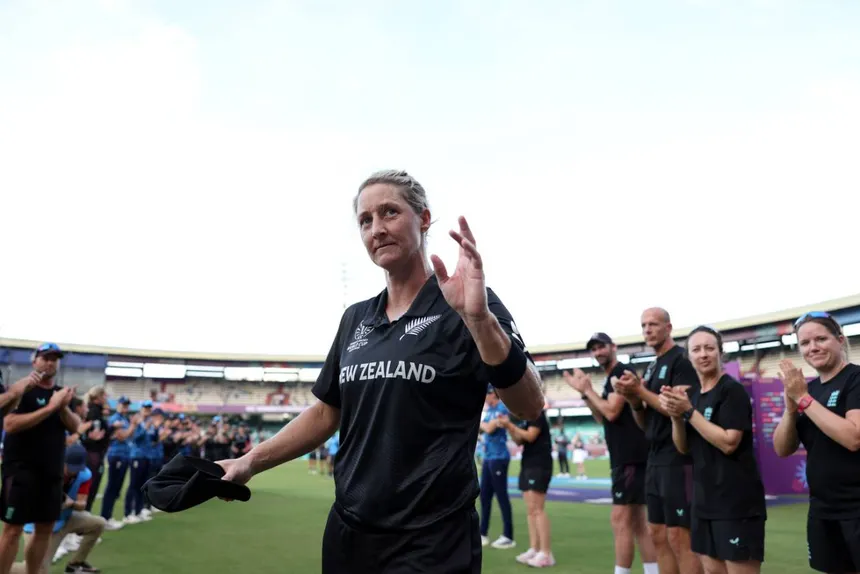
New Zealand star Sophie Devine has sparked an important debate in women’s cricket by calling for a comprehensive review of fielding restrictions and boundary lengths, arguing that current playing conditions are skewed too heavily in favour of batters. Devine believes the women’s game has evolved to a point where some regulations now feel outdated and should be reconsidered — potentially bringing them closer in line with the men’s game.
Speaking candidly, Devine pointed out that modern women’s cricket has seen a significant rise in power-hitting, athleticism, and overall skill levels. With stronger bats, improved fitness standards, and more aggressive batting approaches, she feels that smaller boundaries and restrictive field placements are increasingly tilting the balance away from bowlers and fielding sides.
One of Devine’s key concerns revolves around boundary dimensions. Many women’s matches are played on grounds with shorter boundaries than those used in men’s cricket, often justified historically by differences in physical strength. Devine argues that this rationale no longer fully holds. Today’s elite women cricketers train professionally, hit the ball harder and further than ever before, and are fully capable of clearing longer boundaries.
According to Devine, shorter boundaries can devalue quality bowling and well-executed plans. Good length deliveries and tactical variations are still punished, while mishits frequently clear the rope. This, she suggests, not only frustrates bowlers but also reduces the tactical depth of the contest.
Fielding restrictions are another area she believes needs review. Devine highlighted that limited protection in the ring during key phases of an innings leaves bowlers with very few defensive options. With batters able to access most areas of the field, especially on small grounds, the margin for error becomes extremely thin. She stressed that cricket is at its best when bat and ball are evenly matched — not when one discipline consistently dominates.
Importantly, Devine did not frame her argument as opposition to high-scoring games. Instead, she emphasised competitive balance. Fans enjoy boundaries and big totals, but they also appreciate tactical battles, clever bowling spells, and athletic fielding. When rules consistently favour one side, the overall spectacle risks becoming predictable.
Devine suggested that greater alignment with men’s playing conditions could be a constructive step. This does not necessarily mean identical rules across formats, but a reassessment based on the current realities of women’s cricket rather than legacy assumptions. Longer boundaries, flexible fielding restrictions, and venue-specific adjustments could all be part of the conversation.
Her comments come at a time when women’s cricket is experiencing unprecedented growth — with expanding leagues, increased broadcast coverage, and rising commercial interest. As the sport professionalises further, players like Devine believe governance must evolve alongside it.
Reaction within the cricketing community has been mixed but engaged. Some support the call, noting that bowlers have increasingly been sidelined in limited-overs women’s cricket. Others caution that changes must be data-driven and sensitive to different playing conditions worldwide.
What is clear is that Devine’s intervention has opened a meaningful discussion. As one of the most respected voices in the women’s game, her perspective carries weight — not as criticism, but as a forward-looking push to ensure women’s cricket remains competitive, skilful, and strategically rich.
12BET Shortlisted for Sportsbook Operator of the Year at SBC Awards 2025