

Allrounders make the big picture for Conrad’s South Africa as the head coach’s T20 spin vision takes shape ahead of 2026.
Can’t bat, can’t play? Allrounders take centre stage in Conrad’s T20 spin vision.
With Imran Tahir in white-ball teams in the 2010s and Keshav Maharaj in Tests for the majority of the past ten years, the role of spinners in South African cricket has changed from being optional extras in the mid-1990s to becoming crucial in the mid-2000s. At this point in the Shukri Conrad white-ball era, they may also need to bat.
“It’s ideal if you can stack your side with as many allrounders as possible,” Conrad said from Darwin, where South Africa will play the first of 20 further T20Is in the lead-up to next year’s World Cup. “And when I say allrounders, I mean fully-fledged allrounders: guys that offer quite a lot with the bat, and obviously with the ball as well.”
For this reason, the T20I team for the tour of Australia does not feature either Maharaj or Tabraiz Shamsi, who leads South Africa in wicket-taking in T20Is. Conrad’s options instead include offspin bowling all-rounder Prenelan Subrayen and left-arm spin-bowling all-rounders George Linde and Senuran Muthusamy. With strike rates exceeding 110, Linde, Muthusamy, and Subrayen have all primarily batted at No. 6 or 7, and No. 8 or 9, respectively, during their domestic careers.
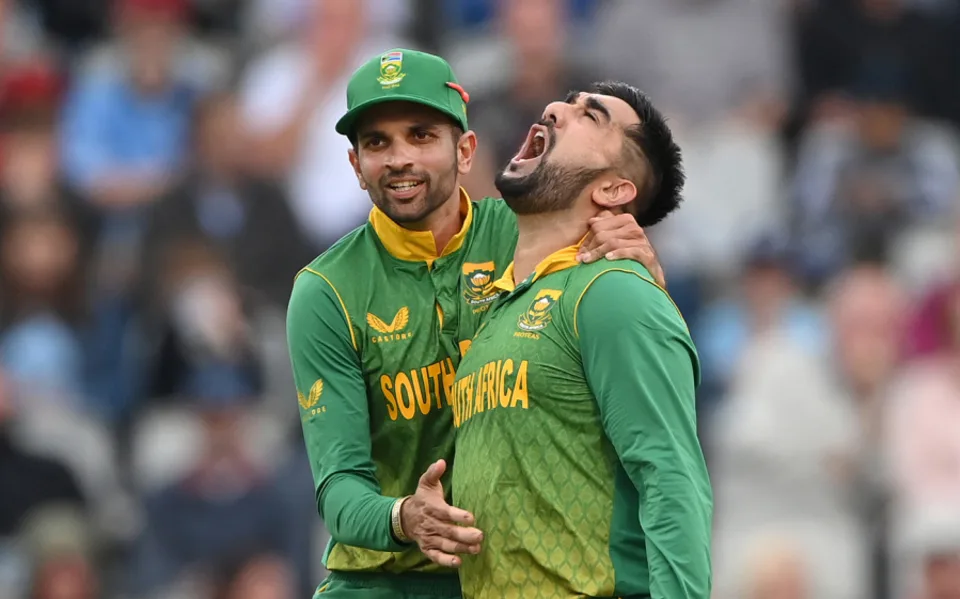
In addition to missing out on the T20 tri-series in Zimbabwe last month, Maharaj and Shamsi both have T20 strike rates below 110 and are not renowned for their batting ability. Conrad stated that Linde and Muthusamy, the spinners he had selected, had the “inside lane” on World Cup selection, implying that Maharaj and Shamsi might not return in this format and that the other three would have to compete for the main spot.
Linde has demonstrated the capacity to perform late-inning cameos and is the most reliable batter of the three on the Australia tour. He scored 30 off 20 during the Zimbabwe tri-series, an undefeated 23 off 15, and 48 off 24 balls in that comeback match against Pakistan. Big hitting will keep him at the top of Conrad’s mind, as he has four T20 fifties to his name.
Muthusamy, who spent the majority of the domestic summer on the Test team’s bench, is his closest rival and made his T20I debut in Harare. Given that he has played in the SA20 on a reasonably regular basis over the past three seasons, including all ten of the Pretoria Capitals’ group stage games earlier this year, Muthusamy was content to wait.
As for Maharaj and Shamsi?
Shamsi, who declined a national contract last year, is awaiting a conversation with Conrad on his future, while Maharaj cryptically stated at the CSA awards that he “only play[s] two formats now.” Conrad said he would speak with Shamsi when he was not selected for Zimbabwe, but he also said he hasn’t been able to do so yet in advance of these tours. Since then, CSA has named Patrick Moroney as a new convenor of selectors, whose role may include telling the two of their fate.
However, that doesn’t have to be decided now. Before the T20 World Cup, South Africa will play five matches against India and the West Indies, three each against Australia, England, and Pakistan, and one against Namibia to open their new stadium. Results will determine if playing so many games is beneficial or detrimental, but it allows Conrad, who is new to the white-ball role, to truly assess the composition of South Africa’s top team.