

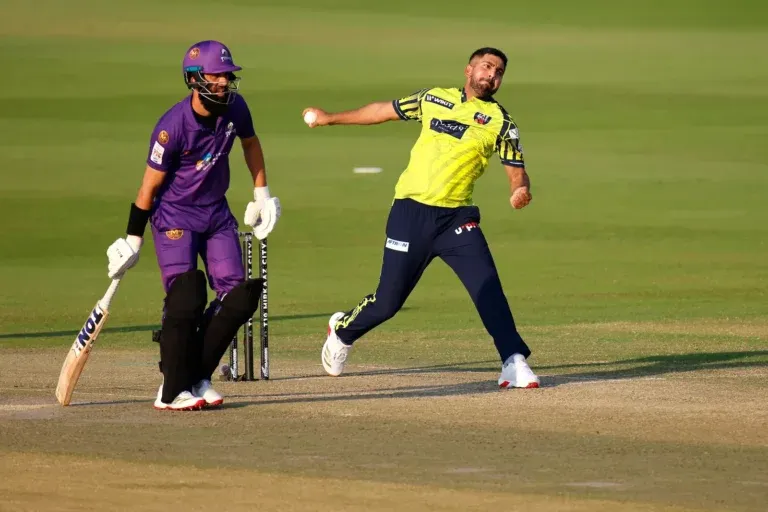
The 2025 season of Abu Dhabi T10 2025 proved a point that often gets ignored in the fireworks of 60-ball cricket: bowlers don’t just survive this format, they can rule it. While the batters were busy swinging for the skies, a handful of pacers turned the tournament into a hunting ground — none more impactful than Andrew Tye and Junaid Siddique, two men who built campaigns on nerve, discipline, and regular breakthroughs.
T10 cricket is a format wired for chaos. The pitch is short, the boundaries feel closer than they are, and batters treat every delivery like it owes them a result. In most years, that means bowlers end the season as statistical collateral — high economy rates, low averages, scattered wicket columns. But 2025 was different. This was the year the ball became the weapon, the trap, and the punchline. Nearly every team leaned on raw pace as their wicket-taking currency. The tournament clocked over 300 wickets, and the vast majority came off express or medium-fast bowling. Spinners still played chess, but the pacers were playing demolition derby, and they were winning.
UAE Bulls were the ultimate beneficiaries of this philosophy. The Bulls entered the tournament loaded with batting power and a bowling attack calibrated to weaponize early pressure. Their strategy wasn’t subtle: hit enough with the bat to put scoreboard pressure on the opposition, then choke the life out of the chase window with disciplined pace. It worked because bowlers like Siddique turned “death overs” into “death traps.” His career trajectory has always shown promise in compressed formats, but in 2025, he matured into a rare breed — a wicket-taking fast bowler who didn’t bleed economy while doing it. His ability to strike without surrendering rhythm gave the Bulls an edge that numbers often fail to measure: psychological collapse insurance. When batting sides saw 150 go up on the board, Siddique made sure the panic started immediately, not gradually.
But the tournament’s bowling architecture doesn’t stop at franchise strategy; it begins with individual campaigns. And in that category, Tye stood tallest. Known globally for his variations, angled seam, dipping change-ups and the deceptive threat of his release point, Tye was built for a world where batters swing blind. He didn’t just lead the wickets column; he led the nights batters lost sleep over. Thirteen wickets in a T10 season is like two seasons’ worth for most bowlers. But for Tye, it was a steady product of consistency, chaos control, and execution under fire. His deliveries had intent: slash run-ups, sharp cutters, back-of-the-hand variations, desert-dry bounce deception, and the casual confidence of a man bowling grenades in phone-booth space. His wickets came in clusters, but his control came in every ball he delivered. He weaponized indecision more than swing, which in T10 is the real superpower.
Why his season became historic wasn’t just volume — it was leverage. Every wicket in this format removes 8-15% of innings stability. Take 13, and you’re erasing entire innings architectures. One of the strongest recurring patterns of the 2025 season was bowler-forced risk. When the asking rate touches 14-16 per over in a chase, batting sides go “unstable-liquid fast.” That’s where bowlers like Tye thrived. He didn’t defend boundaries; he induced them into attempted boundaries that died on the blade or found hands at long-on. That’s not traditional T20 wicket-taking; that’s T10 wicket-extortion.
Yet, what made 2025 even more fascinating was the collective evolution of pace bowling in the league. Traditional powerplay ideas don’t fully apply to T10 — because powerplays are the whole match. In 2025, fast bowlers turned that into opportunity. The week-by-week ebb of the tournament showed teams increasingly trusting pace to generate not only collapse windows, but choke windows. Bowlers who could combine strike with variations, subtle length disguise, angle manipulation, and change-up calibrations moved from “nice to have” to “must deploy.”
Another standout of this bowling renaissance was Rovman Powell — not as a bowler this season, but as the ideal batting foil bowlers had to plan for. Powell’s presence at the crease often forced teams into over-loading pace. That inadvertently benefited bowlers like Tye, who thrive when teams over-deploy fast bowling resources. The more pace gets over-used strategically, the more variation-based pacers become disproportionately lethal.
12BET Shortlisted for Sportsbook Operator of the Year at SBC Awards 2025