

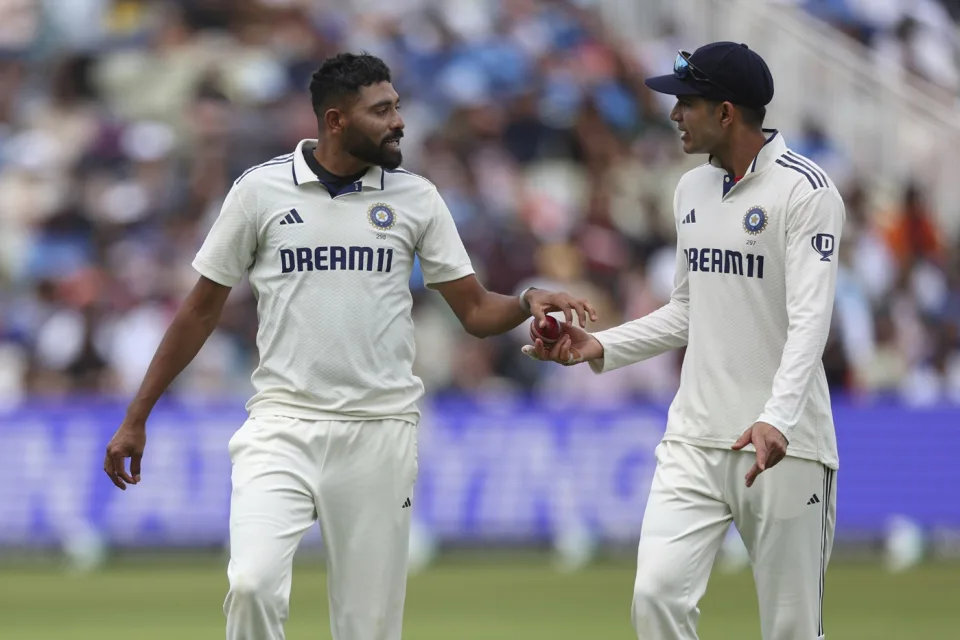
Gill embraces the joys and agonies of Test captaincy as he shows he is ready for the grind of Test leadership.
Gill embraces and shows he is ready for the grind of India’s Test captaincy.
When Chris Woakes came out to bat on Monday morning, Mohammed Siraj and Shubman Gill had a brief conversation and decided to block Gus Atkinson’s single on the final ball of the 84th over. This would give Prasidh Krishna a chance to bat left-handed from the Vauxhall end against the England all-rounder who had come out with a broken arm in a sling.
In order to keep Atkinson from getting bat on ball, Gill requested Siraj to deliver a wide yorker outside off stump. Gill’s request that wicketkeeper Dhruv Jurel remove his right glove and remain vigilant for a throw at the stumps in the event that the batters tried a bye was another crucial component of the strategy.
Both batters left for the bye after Siraj fulfilled his promise and Atkinson was unable to make contact. However, Jurel never removed his glove, and his throw off the stumps was too slow and wide, which greatly irritated India’s top fast bowler in this series. With a thumping chest and wide eyes, Siraj asked Gill, “Bola nahin tune usko” [did you not tell him the plan?]. Siraj would keep looking at Jurel incredulously as he jogged sheepishly to the other end.
Gill would explain after the match why the plan did not take off, with Siraj now chuckling beside him: “He told me to tell Dhruv to take off his gloves to get the run out. By the time I told Dhruv, he (Siraj) was already running in to bowl. So Dhruv didn’t have enough time to drop his gloves and he missed. That’s why he said to me why did you not tell him.”
“We felt even in the second-last ball or last ball, we felt if we go wide yorker there’s a chance of him (Atkinson) missing, which he did in the first one – Dhruv missed the stumps, which happens. But that was the plan that they have to score. We wanted them to take on the fielders and score in boundaries rather than bringing the field inside and they hit a boundary. We didn’t want them to achieve it in one shot. We wanted them to hit maybe two or three shots to be able to achieve the runs because that, I felt, gave us the best probability to be able [to strike], for them to make a mistake and for us to win the match.”
Gill has persuaded everyone throughout the Anderson-Tendulkar Trophy that his ability to score runs is unaffected by his captaincy, but there have been concerns raised over other facets of his leadership. Can he read the scenario well? Is he a skilled strategist? Is he able to speak to his bowlers clearly?
Just two instances that help us comprehend Gill’s captaincy a little better are the ones mentioned above. They demonstrate that while Gill has his own opinions, he is also open to hearing what his players have to say. Siraj is a contemporary who has played with Gill since their India A days.
Gill tells us that rumours concerning his captaincy from the outside won’t have an impact on him. He claims that he has the courage to take the “shots” that are directed at him. There was talk that India had only chosen three quick bowlers on a green pitch at The Oval, where five days of cloudy weather were forecast. Taking that into consideration, Gill gave an explanation for his decision.
“Even in this match a lot of people were saying we could have played a fourth specialist bowler, but the guy who played instead of the fourth seamer – Karun Nair, his fifty in the first innings was equally important for us which helped us to get a decent total. You have to understand and weigh what is the most important. We thought on this wicket, three fast bowlers would be able to do the job for us and they delivered. When your decision goes well people praise you and when it doesn’t, I am aware that there are going to be shots taken at me which I am fine with because at the end of the day I know that I made a decision which is best for the team.”
This has been an epochal series for Gill and India. There are many lessons he will be bringing back to his own country, albeit we are unsure if he writes anything down in his journal. However, Gill stated that his fundamental way of thinking will continue to be balanced, which will contribute in his development as a leader.