

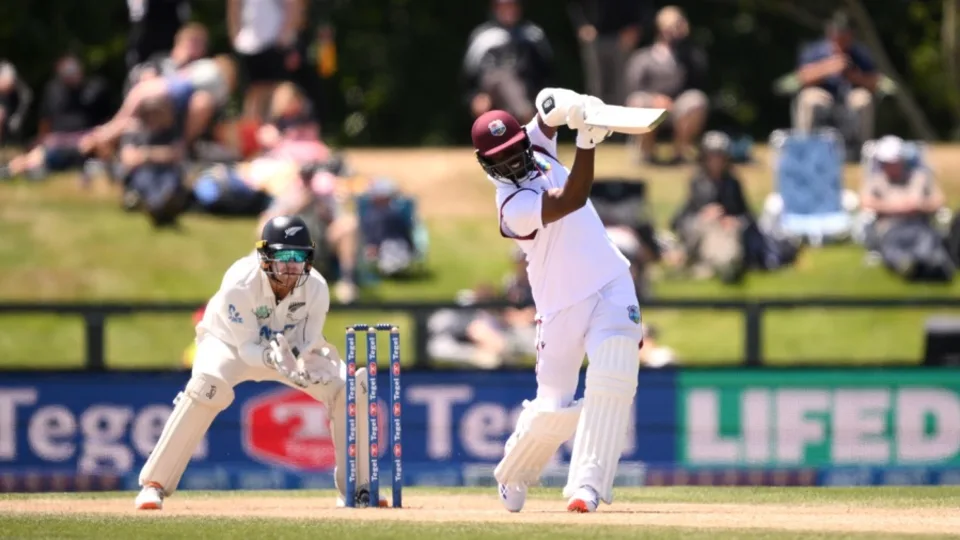
Greaves and Roach put marathon resistance in thrilling draw as both put up 180 runs for the seventh wicket vs NZ.
A heroic rearguard effort from Greaves and Roach, along with Hope ensured West Indies salvaged a thrilling draw after slipping to 72 for 4.
the rest of his 12-Test career combined, as West Indies finally opened their account in the 2025–27 World Test Championship with a hard-earned draw in Christchurch. The visitors survived for 163.3 overs in the final innings — their longest fourth-innings effort in Test cricket in 95 years.
After initially playing second fiddle to Shai Hope in a vital 196-run recovery from 92 for 4 on the third day, Greaves assumed total control of the innings once Hope (140) and Tevin Imlach were dismissed in quick succession. From that point on, he became the immovable centre of West Indies’ resistance.
His maiden Test double century arrived in dramatic fashion near the end, when he cut Jacob Duffy over backward point during the penultimate over of the match. It was just his second boundary of the entire final session, and it prompted a standing ovation from teammates as he reached the milestone in unforgettable style.
Greaves remained undefeated on 202 after enduring 388 balls, transforming what began as a typically expressive innings into a display of sheer toughness and iron resolve. He absorbed countless body blows, faced more deliveries than across the rest of his Test career put together, and suppressed his natural attacking instincts with relentless focus and discipline.
His marathon effort sparked a remarkable reversal of momentum. Just an hour into the day, West Indies had sunk to 277 for 6 while pursuing a towering target of 531. With New Zealand reduced to only two exhausted specialist quicks — Zak Foulkes and Jacob Duffy — the hosts sensed an opening. Instead, Greaves was joined by the returning Kemar Roach, the 37-year-old veteran who batted with extraordinary defiance in his comeback appearance.
Roach finished unbeaten on 58, the highest first-class score of his career, after facing 233 deliveries. Incredibly, he added only five runs from his last 104 balls during a tense final two-hour stretch under the scorching sun on a pitch that had become increasingly lifeless. Still, that remarkable restraint only added to the scale of the broader resistance mounted by Hope, Greaves, and Roach.
New Zealand’s frustration grew visibly through the second and third sessions as they failed to break the Greaves–Roach partnership and were worked into exhaustion. Their sense of injustice peaked when Roach appeared to feather a catch off Michael Bracewell to Tom Latham — a decision they could not challenge, having already exhausted all their reviews.