

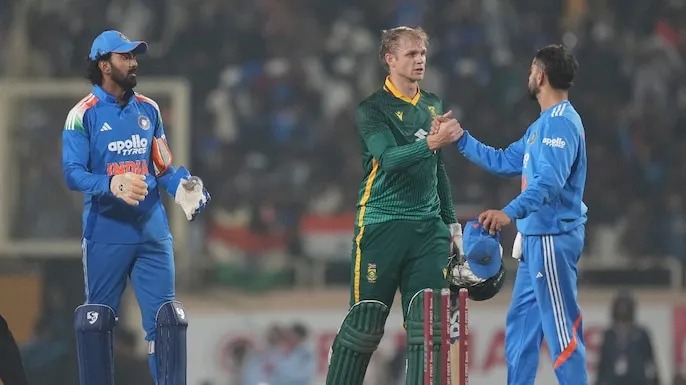
India national cricket team scraped a vital win in the first ODI at Ranchi, holding off South Africa national cricket team in a run-fest that produced 682 runs, 12 sixes from one batter, and a chase that went to the 50th over before falling apart. India’s 349/8 was massive but not match-safe. South Africa’s 332 all out was heroic but not prevailing.
This match confirmed one thing: 50-over cricket is no longer about totals, it’s about timelines. Score 350 first? Cool — but can you bowl when the conditions turn? India did.
India built their innings around a heavyweight partnership. Virat Kohli delivered 135 off 120, launching seven sixes and eleven fours, dictating the best scoring arc for the hosts. It wasn’t reckless hitting — it was run design. Rohit Sharma added 57 off 51, and their 136-run second-wicket stand put India on pace for a total they knew they’d need every bit of.
Middle-phase pros KL Rahul (60 off 61) and Shreyas Iyer (36 off 27) kept the floor rising. Iyer’s cameo was strategic micro-bursting — pressure soaking via acceleration windows without exposing the finishers too early. The final ten overs were a lower-order stockpile, shepherded into shape by Axar Patel’s 27 off 14 and Washington Sundar’s 25 off 22, ensuring India crossed 340, not just 300.
Then came defence logic: dismiss optimism early. South Africa were 11/3 by the fourth over. But unlike teams that fold, SA found a counter-timeline. Kamil Mishara gave them an early 50-run stand that demanded respect, but it was Matthew Breetzke who re-wired belief with a flowing 72 off 69. And just when control threatened to slip, India pulled the lever they held back in daylight.
Kuldeep Yadav didn’t just bowl; he altered day-night economics. Kuldeep Yadav finished 4/57, breaking key partnerships and drawing errors through pace-on-pitch spin, exploiting a surface that fractionally two-paced at night. This was the match’s junction: pressure generated, not inherited.
Marco Jansen (70 off 55) and Corbin Bosch (67 off 63) dragged the chase into final-five-overs territory, rebuilding from India’s early bite. But India had planned for endings, not middles. Harshit Rana delivered the first shock to SA’s reset in his very first over. Harshit Rana struck twice in six balls, slicing into the chase before it could pivot from resilience to takeover.
By now, the chase needed 18 an over from 24 balls — possible in 2022, absurd by 2025 standards unless you have batting health and bowling context to steal control back. South Africa had health; India had context.
The final over, bowled by Prasidh Krishna, was the decider’s drumbeat. Krishna’s plan was boring by optics, unbeatable by data: hit the deck, cramp the room, force geometry. The last batter Bosch holed out on the second-last ball. Execution beat improvisation.
The victory underlined India’s ODI axiom: bat for depth, bowl for timeline control. For South Africa, it was a 49-over story they couldn’t convert at the one moment it mattered. They were close, but close is the new loss in 50-over cricket.
12BET Shortlisted for Sportsbook Operator of the Year at SBC Awards 2025