

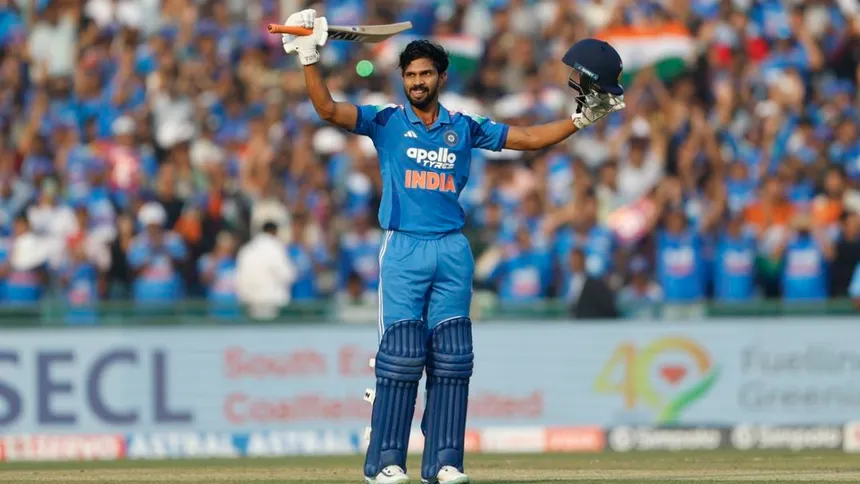
The 2nd ODI of the 2025–26 India–South Africa bilateral series was one of those games where the scoreline tells less than the innings do. India lost by 4 wickets, series knotted 1–1, but the match underscored what keeps India ahead in 50-over cricket — batting layers that don’t cave, even when a game slips. The hundreds from Virat Kohli and Ruturaj Gaikwad were not just milestones; they were a mission statement of India’s ODI backbone. They built a total with decisiveness, placement precision, and partnership discipline, showing exactly why India’s batting DNA remains competition-resistant.
Rohit Sharma gave India the opening template — stability before spectacle. But once the platform was set, Kohli stepped into innings-sculptor mode. Kohli’s 50-over craft has evolved into a segmented pressure model: absorb early, dictate middle, accelerate late, protect partnerships always. That’s the real quality that separates ODI greatness from ODI gimmickry. His century was built on judgement, ground mapping, and risk selection, not risk worship. Kohli bats as though each over has a consequence ledger. He cashes in boundaries when they’re risk-clean, rotates strike when bowlers hunt ego-shots, and accelerates only when his maths says momentum > mistake probability. His knock had no gratuitous gear — every run had purpose, every ball had a plan. In a world oversaturated with T20 chaos, Kohli remains the proof that ODIs reward batters who score without surrendering structure. The format bends toward calculated intent, and Kohli still bends the format back.
At the other end, Gaikwad provided the elegance India selectors increasingly back: calm construction with late-phase striking usability. Gaikwad’s red-ball grooming through Ranji Trophy made him a batter who respects innings architecture. His century wasn’t a power outburst — it was boundary carpentry. He leaned on timing purity, boundary-arc awareness, and risk smoothing that keeps innings solvent. Gaikwad’s ODI success comes from a trait that scales upward: failing slow. That sounds counterintuitive until you watch 50-over cricket. A batter who brings equilibrium early and still has fire late is auction gold, but 50-over currency is different. It’s about soft touches early that blunt new-ball pressure and decisive violence later that carries an innings from “defendable” to “dominant.” Gaikwad did exactly that, changing tempo only when the pitch, field, and scoreboard allowed infractions. His innings quality was the kind that wins 8/10 days. This was just one of the 2.
Despite India’s total settling into a commanding range, South Africa chased with more clarity on the day, led by Aiden Markram, whose hundred and chase stewardship sealed the result. But Markram’s success also highlighted what India already possess in troves: batting temperament that doesn’t disintegrate mid-format. India’s best players don’t just score, they sequence. They don’t hunt phases — they own them.
Kohli and Gaikwad both batted like players playing chess, not cha-cha. Their centuries may not have delivered the match, but they delivered something more durable for India’s 50-over horizon — proof of identity. India didn’t choke the format; they showcased the format’s ideal traits and lived them. This match wasn’t a batting failure — it was a chase execution superiority from South Africa on the specific day. India’s ODI leaders remain systems players: Kohli the innings phaser, Gaikwad the placement calibrator, Sharma the timeline stretcher.
12BET Shortlisted for Sportsbook Operator of the Year at SBC Awards 2025