

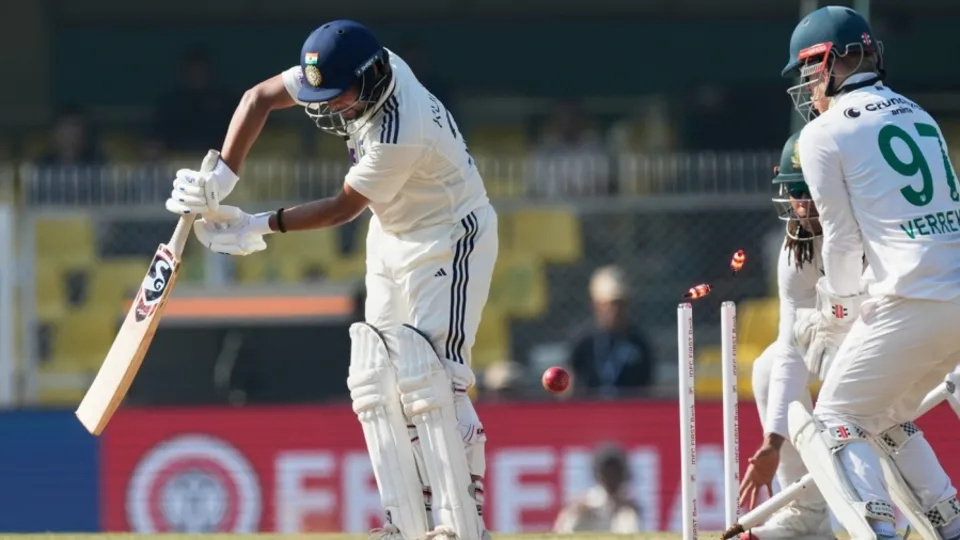
India’s Test team a perfect example of a whole riddled with holes that is leading to disproportionate results.
India’s Test team – a whole too full of holes.
There is no way that things could get any worse. Up is undoubtedly the only way out of this situation.
Throughout the past year and a few home Test matches, India’s supporters must have comforted themselves with these ideas. Every time, all they’ve learnt is that things may undoubtedly worsen and that there are always other options.
from Bengaluru to Mumbai via Pune. And from there to Kolkata and Guwahati, following the short break in Ahmedabad and Delhi. A journey that largely travelled south and travelled all over India.
Against New Zealand, it was zero-three. Against South Africa, zero-two.
For India and their supporters, this is abnormal. Because these outcomes have come so close after a period of unthinkable dominance, it feels particularly strange.
Sometimes, great players make foolish decisions. But why did India go from near-invincibility to complete fallibility in domestic circumstances so quickly? Do their outcomes accurately reflect their calibre? Are they truly this awful? Does this indicate a more serious problem with the nation’s red-ball ecosystem, or is it just a blip?
South Africa and New Zealand were outstanding touring teams that were specifically designed for Indian circumstances using knowledge gained from, among other things, India’s long history of domestic success. These teams were designed to compete and take advantage of any opportunities that presented themselves.
And they continued to have good fortune, including the toss. Additionally, South Africa got India at a different stage of the shift, when inexperienced players were still getting their bearings, while New Zealand caught them at one stage, when older players were starting to show signs of decline.
Even after removing such disclaimers, it still seems unbelievable that India failed to win or draw any of these five Test matches. Yashasvi Jaiswal, Ravindra Jadeja, and Pant performed all five of them. Mohammed Siraj and Jasprit Bumrah each played four, while KL Rahul and Kuldeep Yadav (as well as Gill, sort of) each played three. These are seasoned, well-known Test cricket players.
However, occasionally minor deficiencies and flaws in strategy and staff can compound to produce disproportionately negative outcomes.
In this South Africa series, India has chosen a number of all-rounders. They were all deserving of selection as individual players. Last year, Washington Sundar made a comeback to Test cricket as a far better bowler and excelled in England with both the ball and the bat. Even though Axar Patel hasn’t played Test cricket in a year, his bowling has always appeared perfect for Indian surfaces, and he can bat in a variety of lower-order scenarios.
Even when regular keeper Pant returned from injury, India had no choice but to select Dhruv Jurel because of his exceptional form for both India A and the Test matches against the West Indies. Even though he wasn’t quite ready, Nitish Kumar Reddy, the most controversial of these choices in home Tests, had demonstrated sufficient signs of belonging at the Test level, especially with the bat.
However, as a result, India entered this series with vulnerabilities that they most likely should have anticipated. Shubman Gill was eliminated from the series after facing just three balls in their first bat turn.
The fact that India played with 10 men for the whole Test harmed them greatly, and it hurt them even more in the second Test when they were unable to find a suitable replacement who batted right-handed and was a specialist batter. India has exposed themselves to this situation by choosing Reddy for their team.
Two, they had purposefully selected a trio of players with nearly comparable strengths by selecting Washington and Axar as their fingerspinners behind Jadeja. Pitches with a sharp, early turn are ideal for all-arounders who are fast, accurate fingerspinners.
Additionally, India’s middle order in Guwahati appeared unsuited to the circumstances in Gill’s absence. The compatibility of bowlers to conditions is a topic we frequently discuss, but it can also apply to batters. In low-scoring situations like Kolkata’s, a lineup like India’s in Guwahati, with lots of depth and theoretical flexibility, could be very helpful. However, the conditions of India’s opening innings in Guwahati required hitters who had scored large hundreds on a regular basis during several first-class seasons.
The Cheteshwar Pujara and Kohli of 2016–17 could not be called up by India to bat at Nos. 3 and 4, because their team lacked anyone of that calibre or experience.
Therefore, despite the demonstrated skill of India’s veteran players, the promise of their younger players, and the unique qualities of their all-rounders, the pieces came together to form a disorganised whole. Despite their bad luck with the toss and injuries, that team could still have defeated a weaker opponent. But against a strong South Africa team that had just drawn a series in Pakistan and won a WTC final, the entire game was just too flawed.