

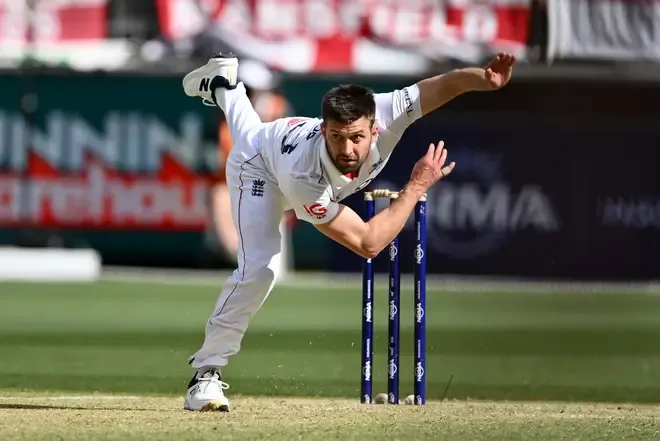
England may have found themselves under sustained pressure on Day 2 of the third Ashes Test at Adelaide, but Mark Wood ensured the contest did not drift completely Australia’s way. With the match threatening to slip beyond reach, the express fast bowler produced a determined and aggressive spell, finishing with four wickets to provide England some much-needed late resistance with the ball.
By the time Wood came into his own, Australia were already in a strong position. Steven Smith’s commanding century had anchored the innings, partnerships had blunted England’s earlier efforts, and the scoreboard pressure was beginning to tell. England’s bowlers had worked hard, but breakthroughs were sporadic. That was when Wood injected urgency, pace, and intent into England’s attack.
Operating at high speed, Wood focused on attacking the stumps and pushing batters onto the back foot. His pace immediately unsettled Australia’s lower middle order, forcing hurried shots and mistimed strokes. Unlike earlier spells where Australia were able to leave or defend comfortably, Wood’s deliveries demanded decisive responses. The result was a cluster of wickets that briefly shifted momentum back toward England.
Wood’s first breakthrough came from sheer pace and bounce, drawing an error from a batter looking to defend off the back foot. As confidence grew, he mixed short balls with fuller deliveries, keeping batters guessing and preventing them from settling. His energy was unmistakable — long run-ups, visible intensity, and clear leadership of the attack during a difficult phase of the match.
What made Wood’s four-wicket haul particularly valuable was the timing. Australia were closing in on a massive total, and England desperately needed to limit the damage. By striking late in the innings, Wood ensured Australia did not run away with an even more commanding lead. His spell helped England wrap up the innings before the deficit became psychologically overwhelming.
From a broader perspective, Wood’s performance stood out in a bowling effort that had often lacked penetration. While others focused on containment, Wood was willing to take risks, bowl attacking lines, and accept the possibility of conceding runs in pursuit of wickets. That mindset is crucial in Test cricket, especially in Ashes conditions where pressure alone rarely dismisses well-set batters.
Physically, Wood’s spell was demanding. Bowling at high pace deep into the second day tested his fitness, particularly given his recent injury history. Yet he showed no hesitation, repeatedly hitting the deck hard and challenging batters with short-pitched deliveries aimed at the body and helmet. His durability across the spell offered England encouragement amid otherwise difficult circumstances.
For England’s leadership group, Wood’s effort was a reminder of his importance to the attack. Even when the match situation is unfavorable, his pace can change the tone of a session in a matter of overs. While Australia still held a significant advantage at stumps, Wood’s wickets ensured England remained competitive rather than completely overrun.
As England looked ahead to their own batting response, Wood’s four-wicket burst served as a morale boost. It demonstrated that Australia were not invincible and that sustained aggression could still produce rewards. In a day largely dominated by the hosts, Mark Wood’s spell stood out as England’s defining contribution — a moment of fight, intent, and resistance in the face of mounting pressure.
12BET Shortlisted for Sportsbook Operator of the Year at SBC Awards 2025