

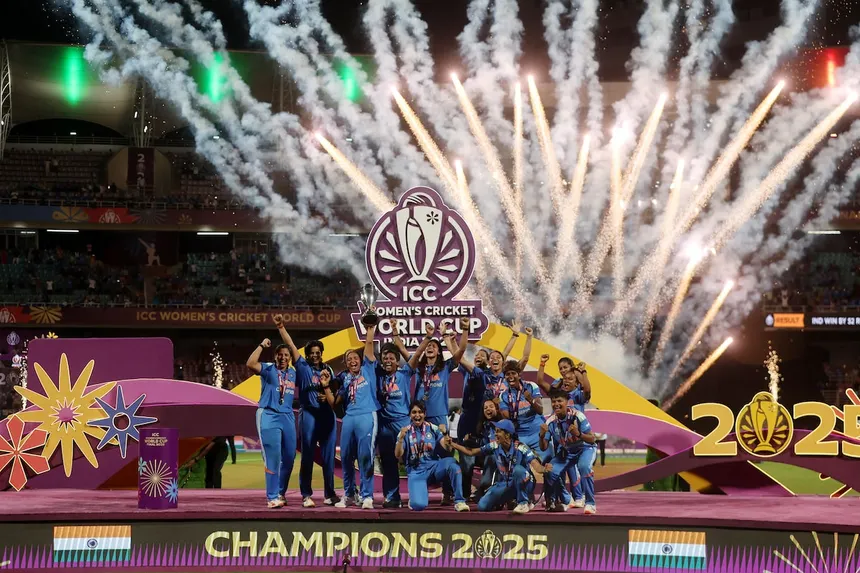
India’s historic triumph in the 2025 ICC Women’s Cricket World Cup has resonated across the nation, drawing praise from every corner — led by Prime Minister Narendra Modi himself. The Prime Minister’s public tribute to the women’s team underscored the magnitude of their achievement and marked one of the most prominent examples of government-level recognition for a women’s sporting success in India’s history.
Shortly after India’s 52-run win over South Africa in the final, Modi took to social media to hail the victory as “a defining moment for Indian sport.” He congratulated captain Harmanpreet Kaur and the entire team for their “unwavering spirit, determination, and unity,” noting that their journey had inspired an entire generation of young girls to dream bigger. He also emphasized that the triumph was not just about cricket but about national pride and empowerment — a signal that the government views this moment as culturally transformative.
President Droupadi Murmu and several cabinet ministers followed with messages of congratulations, echoing the sentiment that the victory represented a turning point for Indian women’s sport. The tone of the statements reflected not just admiration but commitment — the implication being that such milestones deserve institutional and infrastructural support.
While the celebrations have gripped the country, the question of a public victory parade for the team remains unanswered. Traditionally, after major men’s cricket titles, the Board of Control for Cricket in India (BCCI) has organized grand processions — the most memorable being after India’s 2007 T20 and 2011 ODI World Cup wins, where open-top buses carried the players through packed city streets. However, BCCI officials have so far maintained that “nothing is finalized” regarding a similar celebration for the women’s team.
Insiders suggest logistical considerations — including scheduling conflicts, international commitments, and coordination with state authorities — as reasons for the delay. Yet, many in the cricket community argue that the symbolic weight of such a parade would far outweigh the logistical hurdles. For players who have shouldered the pressure of lifting an entire sport into mainstream conversation, a national celebration would serve as tangible acknowledgment of equality.
The larger narrative here extends beyond festivity. Government recognition and public validation can play a critical role in shaping how women’s cricket is viewed and funded in the coming years. The Prime Minister’s early and emphatic support has already raised expectations of increased investment in women’s cricket — whether through enhanced central contracts, expanded domestic structures, or improved grassroots programs.
Social media has amplified calls for a parade, with fans, former cricketers, and celebrities urging the BCCI to give the women’s team the same platform that past men’s champions received. The sentiment is clear — this win isn’t just another trophy; it’s a cultural shift that deserves to be celebrated as such.
As the euphoria continues, the final chapter of India’s World Cup glory story remains unwritten. The nation has spoken, the Prime Minister has applauded, and now all eyes turn to the BCCI. Whether or not the team is honoured with a public parade, the message from India’s corridors of power is already loud and clear: this victory belongs to everyone.
12BET Shortlisted for Sportsbook Operator of the Year at SBC Awards 2025