

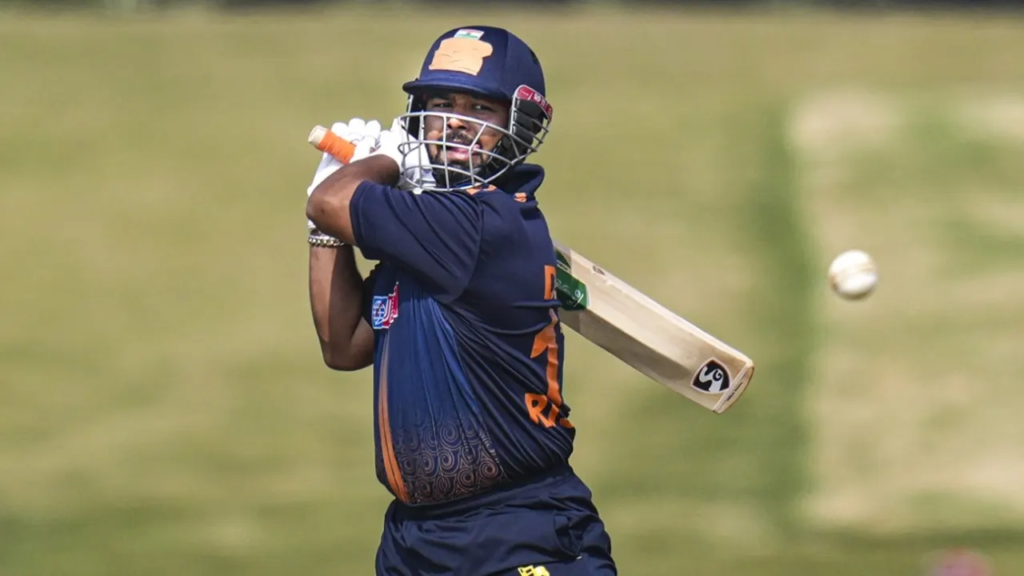
Pant stays to his roots as he looks to resurrect white-ball career as he shed the flamboyance and went for hard graft.
From the BCCI’s Centre of Excellence, one can see an airport runway in the distance. The images of planes lifting off reach the ground, but the noises do not. Rishabh Pant was prepared to take off for the majority of Delhi’s innings, batting first after Gujarat put him in. Despite walking in at 98 for 3 in the 20th over, he maintained his composure.
When there are no large crowds or traffic on the outskirts of Bengaluru, the sounds in the middle of the game—the taps of the bat as the bowler runs in, fielders raising the volume for an appeal, and sighs as a bouncer whizzes past the batter—punctuate the game’s tempo.
Compared to when Virat Kohli had sprinted to a 29-ball half-century, the surface provided some zip and carry for the faster bowlers, making life more challenging for batters. By the time Vishal Jayswal’s brilliant left-arm spin bowling stopped him, he had amassed 77 of Delhi’s 108 runs.
Survival was crucial since Delhi was in danger of running out of batters due to the pitch being spread, and Pant was trapped in with no way out. In order to reach his 20s and eventually his 30s, he primarily tucked deliveries past the in-fielders to accrue singles.
Early on, Pant mostly steered clear of showy, soaring strokes in favour of crease occupation. His careful stroke play was at odds with the power he still poured into them, and his immobility at the crease was at odds with the power that loaded up each time he tapped his bat on the pitch. He reached 49 with another tuck across the pitch.
Then, when he watched Ravi Bishnoi bowl a wrong’un away from his hitting arc and latch onto it with a vicious stroke over the line, he flicked a switch. The ball was blasted far beyond the long-on boundary, although his hand did not quite come off his bat as it does with many of his strong strokes.
Shortly after turning fifty, he was on his knees, nearly toppling over to the opposite side as he swept past deep-backward square leg. It had taken him 62 balls to complete his half-century. Off his following sixteen, he added twenty. He was standing deep in his crease when a ball rose awkwardly and flew up from just short of a solid length outside off, which was the best shot of this run sequence. He turned his bat, his follow-through arc resembling a helicopter shot. As a result, the ball appeared intended to cramp him as it raced to the cover boundary.
Pant is on the fringe of India’s white-ball ambitions, although his most recent ODI for the country was against Sri Lanka in August 2024, more than a year ago. It’s widely believed that although his high-risk, high-reward approach works well in Test cricket, he has struggled to find his own pace when faced with a short overs.
Like fellow batter-keeper Ishan Kishan did during the Syed Mushtaq Ali Trophy, Pant has a fantastic chance to develop a fresh run-scoring template and a path back into form.