

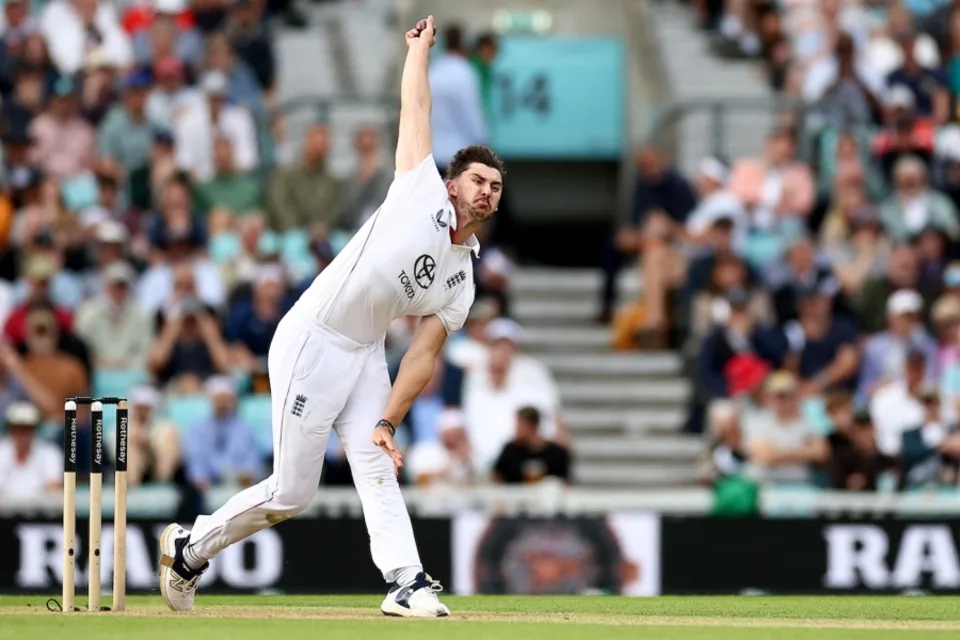
Raw pace in abundance, but can England pacers deliver the goods and do they have the miles to back the pace.
England are banking on their young fast bowlers, but can they pit raw pace against Australia’s experienced attack?
Stuart Broad was the first. James Anderson came next. It’s Chris Woakes now. Since the 2023 Ashes, England has lost precisely 1500 wickets of Test match experience due to those three international retirements; the seven fast bowlers they brought to Australia for the 2025–2026 series only had a third of that total (566).
It is England’s first Ashes tour without Broad since 2006–07 and their first without Anderson since the 2002–03 series, which took place before Jacob Bethell was even born. Jofra Archer, who has played 15 Tests in six years, is the third most-capped quick among the seven seamers on this trip, with Ben Stokes holding more than half of the 205 Test caps.
However, England hopes that their attack’s depth and quality will outweigh their experience. Aamer Jamal (18 wickets at 20.44) and Shamar Joseph (13 wickets at 17.30) have both led visiting attacks in Australia in their first Test series since they were defeated 4-0 just four years ago when they sent seven seamers with 1547 Test wickets between them to Australia.
Only Anderson and Broad, two of England’s six seamers, had even ten Test caps prior to the commencement of the series when the team previously triumphed in Australia in 2010–11. However, their rookies were successful. Following Broad’s injury, Chris Tremlett claimed 17 wickets in three Test matches, while Tim Bresnan and Steven Finn combined for 25.
Pace is a crucial component of the 2025–26 attack, which has frequently been lacking in earlier England teams who have travelled to Australia. In Test cricket, six of their seven seamers—Jofra Archer, Gus Atkinson, Brydon Carse, Stokes, Josh Tongue, and Mark Wood—have recorded speeds exceeding 90 mph/145 kph. The one exception, Matthew Potts, is no slouch.
The attack’s composition is the outcome of an intentional effort by England’s managing director, Rob Key, to change perceptions about fast bowling within the English system. “It’s not like we are going to go there with the same formula and expect different results,” stated Joe Root, who led England to 4-0 losses during their last two Ashes journeys.
In June 2022, Potts made his debut in the inaugural “Bazball” series against New Zealand. Since then, three other fast bowlers—Tongue, Atkinson, and Carse—have joined the Ashes team. All four are big, fast right-arm bowlers who have developed close bonds off the pitch and rely more on seam movement than swing.
England has other weapons besides pace at their disposal. Australia will probably deploy five in their top eight, and Archer’s effectiveness against left-handers is well-established. Carse is a unique English bowler who is more at ease with the Kookaburra ball than the Dukes, and Atkinson is hard to leave alone due to his lateral movement.
After utilising an injury break to improve his alignment at the crease, Stokes rarely bowled better than he did against India. In his first six Test matches, Tongue has grabbed a wicket every 44.1 balls due to his difficult beyond-perpendicular action. Potts is the most accurate seamer in England, and Wood is a master of reverse swing.
However, there is a persistent sense that England may be a latecomer. Seamers have claimed a wicket every 47 balls on average over the last four Test summers, compared to one every 61 balls in the preceding four. Australian conditions have changed in recent seasons, with “curators” leaving more grass on fields and the tempo of play rising substantially.
When faced with a green top, it’s uncertain where England will go. Sam Cook’s lacklustre debut performance against Zimbabwe left Potts as the closest thing to a classic English seamer, while Woakes’ record in Australia (16 wickets at 51.68) may have entered the picture had a shoulder injury not accelerated his departure.
However, how frequently England will have access to Archer, Stokes, and Wood is the question that will determine the outcome of the series. Wood hasn’t bowled competitively since the Champions Trophy, Stokes has only finished one full series as an all-rounder in the last three years, and Archer has only played two Test matches since February 2021 due to injury.
Additionally, England lacks a reliable world-class spinner, in contrast to their rivals. Although there are still injury concerns for Australia going into the first Test, they are confident that Nathan Lyon can play for extended periods of time. Although Shoaib Bashir has frequently played a similar position, his economy rate of 3.78 indicates how frequently he bowls hit-me balls.
Despite all of England’s progress under Stokes and McCullum, it is still very evident that for them to reclaim the urn, everything must come together. “Australia are obviously the favourites,” Wood recently stated. “In their own circumstances, they are extremely difficult to defeat. We haven’t won many games here at all, as they’ve demonstrated for several years.”
After losing 13 of their previous 15 Test matches in Australia, there was no need to continue with the same strategy, which is the unavoidable reality that led England to formulate this attack. Pace and potential abound in their fast-bowling “pack”; now it’s time for accuracy and performance.