

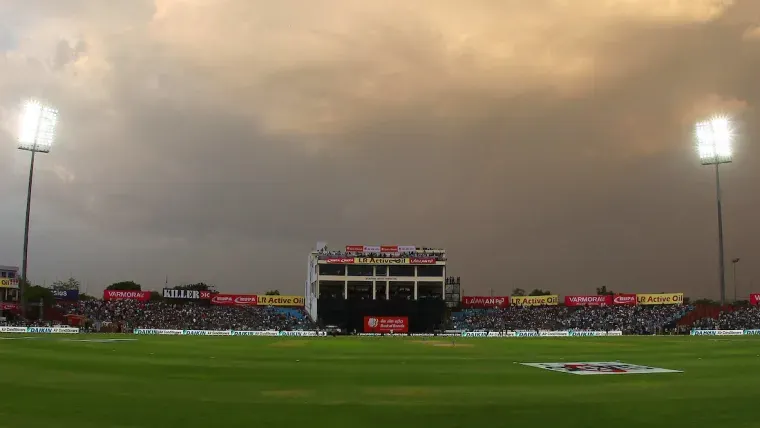
With IPL 2026 planning already underway, franchises are being forced to think beyond cricketing factors as off-field uncertainties cloud the availability of traditional home venues. Royal Challengers Bengaluru and Rajasthan Royals are among the teams actively exploring Pune’s MCA Stadium as a potential home base, with their regular grounds in Bengaluru and Jaipur currently not confirmed due to non-cricket issues.
The M. Chinnaswamy Stadium in Bengaluru and the Sawai Mansingh Stadium in Jaipur have long been central to the identity of RCB and Rajasthan Royals respectively. However, administrative, infrastructural, and logistical complications — unrelated to on-field readiness — have created enough uncertainty for franchises to begin contingency planning. In the IPL ecosystem, venue clarity is essential months in advance, especially for scheduling, broadcasting, ticketing, and sponsor commitments.
For RCB, the Chinnaswamy Stadium situation is particularly sensitive. The venue is one of the most iconic in the league, known for packed crowds, high-scoring matches, and strong commercial pull. Any disruption there directly affects not just the team but the league’s broadcast value. While the stadium itself remains cricket-ready, unresolved external factors have prevented confirmation, pushing RCB to quietly evaluate alternatives rather than risk last-minute chaos.
Rajasthan Royals face a similar dilemma with the Sawai Mansingh Stadium. Jaipur has been a reliable IPL venue, but recent non-cricket developments have complicated its availability. For a franchise that has prioritized stability after years of logistical disruptions, the possibility of entering another season without a confirmed home base is something management wants to avoid. As a result, parallel planning has become necessary.
Pune’s MCA Stadium has emerged as a strong fallback option for multiple reasons. The venue is modern, well-maintained, and has successfully hosted IPL seasons in the past, including during periods when franchises were forced to relocate due to extraordinary circumstances. Its infrastructure meets broadcast standards, and its pitch offers balanced contests that suit a variety of playing styles.
Logistically, Pune is also attractive. Its proximity to Mumbai simplifies travel and operations, and the city has a proven record of handling large sporting events. For teams, relocating to Pune would be far less disruptive than shifting to a completely new region with unfamiliar conditions and weaker local support systems.
That said, using Pune as a home venue is not without downsides. Neither RCB nor Rajasthan Royals have a natural fan base there, which dilutes the home advantage that franchises fiercely protect. Fan engagement, local sponsorships, and match-day atmosphere all take a hit when teams are forced away from their traditional homes. For brands built around city identity, this is a significant compromise.
Still, from a practical standpoint, franchises prefer certainty over sentiment. IPL planning timelines are unforgiving, and venue ambiguity can affect everything from preseason camps to commercial agreements. By identifying Pune early as a viable alternative, teams ensure they are not caught unprepared if final approvals for Bengaluru or Jaipur fail to materialize in time.
Importantly, these discussions are precautionary rather than final. Both RCB and Rajasthan Royals continue to hope their home venues will be cleared, and the BCCI remains engaged with local authorities to resolve outstanding issues. However, the willingness of franchises to explore neutral options underlines a growing reality: IPL teams can no longer rely solely on tradition when non-cricket factors threaten operational stability.
12BET Shortlisted for Sportsbook Operator of the Year at SBC Awards 2025