

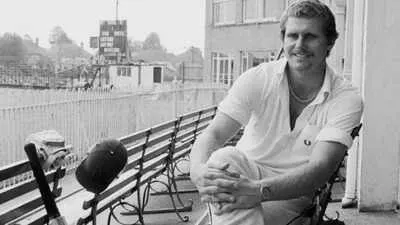
Robin Smith passed away on 2 December 2025 at the age of 62, closing the final chapter on one of England’s most defiant batting careers. In an era before T20s rewired the sport into overdrive theatrics, Smith represented the rarest England commodity for Test cricket at the time — a batter who didn’t negotiate with intimidation, pace, or expectation. He confronted it head-on. Modern English cricket is built on brave tactics and hybrid skill sets, but Smith’s legacy reminds everyone where that bravery originated: in a mindset thick enough to stare down Australia without blinking.
Nicknamed Judge, Smith did not receive that tag for aesthetics. He earned it for clarity — judging lengths early, lines brutally, and bowlers’ egos without reverence. Between 1988 and 1996, Smith played 62 Tests for England, scoring 4,236 runs at an average of 43.22, with 9 Test centuries. Those numbers are strong, but they undersell the story. Smith wasn’t a volume accumulator cushioned by friendly surfaces. He was a pressure absorber bathed in hostility. The context that forged his legend most vividly came against Australia during the 1993 and 1994–95 Ashes contests. When bowlers hunted psychological scars, Smith refused to supply them.
Smith’s batting qualities aged like iron. Compact stance. Early trigger. Minimal foot noise. Maximum decision keenness. His method was simple to describe but almost impossible to bowl at comfortably: play the ball late, play it straight, murder anything short, survive anything clever, and don’t lose your head in the process. That’s why he remains most famous for his back-to-back centuries at Old Trafford (167 and 123) during 1993 Ashes 4th Test — one of the rare occasions England fans saw an Australian attack visibly frustrated, rather than England batters visibly fractured.
His approach would be future-proofed in any decade, including this one. Today’s batters are trained in phasing innings — break 120 balls into clusters of consequence windows. Smith did that instinctively before it became coaching doctrine. Bowlers hate predictability, but they hate this predictability most: a batter who will not self-destruct for you, no matter the scoreboard rate, crowd rate, or intimidation rate. Smith didn’t bat for applause. He batted for consequence denial. The bowlers had to win their wickets, not wait for them.
Smith also represented a transition point in England’s batting culture. His career ran parallel to players like Mike Atherton, Atherton the planner, Smith the executioner of anything loose. Smith complemented teams built on endurance by providing late violence without initial gambling. That balance — calm first, carnage later — has since become the batting goal across leagues like England’s Vitality Blast and the IPL system abroad. Smith embodied the instinct England cricket eventually leaned into years later for white-ball assault windows via players like Jos Buttler and middle-order hybrid approach prototypes like Will Jacks. But forget the fireworks comparisons; this is about the mental wiring that allows fireworks to matter: innings solvency, phase clarity, and pressure resistance without ego meltdown.
Smith’s influence stretched into ODI cricket too. He played 71 ODIs for England, scoring 2,018 runs at a strike rate that was considered aggressive for its time. He could hit — hard — but he hit after the innings could afford it. This is the batting trait too many young hitters get backward today: ignition is easy. Insolvency is dangerous. The best hitters stay long enough to ruin bowlers, not lineups. Smith did that, consistently.
Off the field, Smith remained connected to cricket through coaching and mentoring roles, including international youth batting work in the UAE. He watched formats multiply — T10, T20, The Hundred, franchise chaos, international congestion — but his message stayed singular: cricket rewards batters who read the game, not batters who just swing at it. Bowlers should fear your judgement before your shots. If they fear your shots first, you’ve already given them a wicket window.
Robin Smith didn’t change cricket’s formats. He changed England’s belief in what a batting spine looks like under siege. And history will remember him for the trait all eras eventually demand most harshly: the bat that never self-snaps for the opposition’s convenience.
12BET Shortlisted for Sportsbook Operator of the Year at SBC Awards 2025