

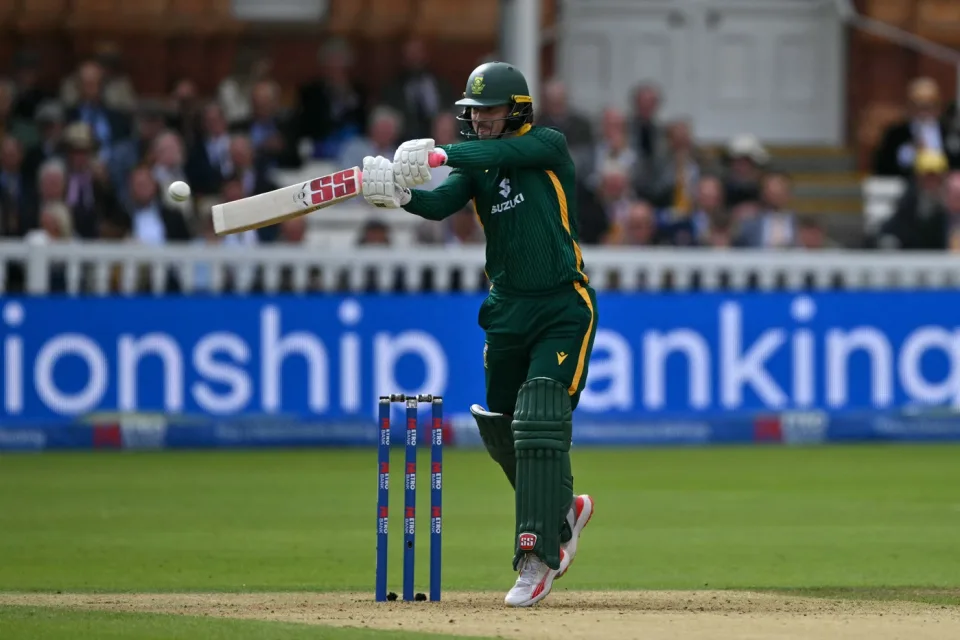
South Africa tick most boxes in their England series win as they have quite a few positives to take regardless the drubbing.
Breetzke must play, Maharaj out in front, room for Jansen – South Africa ODI lessons.
Despite the anomaly in the two dead rubbers, South Africa has won consecutive ODI series and started preparing for the 2027 World Cup. Even while they have made great strides—their victory in England was their first since 1998, and their win in Australia was their fifth straight bilateral ODI series victory over them—there are still some problems to be resolved.
South Africa has won 16 of 23 games since 2023 when defending a total, but they must improve their fielding strategy first, particularly when it counts. On the path to 2027, keep in mind these five points.
Breetzke is a must for South Africa in ODIs
Matthew Breetzke’s five consecutive ODI fifties cemented his place on the list of players to watch, and perhaps it should become a campaign slogan. Breetzke has struggled to make the starting lineup, as seen by the fact that it took him eight months to play those five games, but he has now argued for sticking there.
Given that Heinrich Klaasen and Quinton de Kock have both retired from this format, Breetzke should participate in as many games as possible because he has the ability to take on the mantle of match-winning.
Since he has been an opener for the majority of his career, he ought to be batting higher than No. 4. South Africa prefers to play aggressively, and Breetzke’s strength at the square of the wicket makes him hard to stop.
Top-order Muddle
Whether Aiden Markram and Ryan Rickelton, who teamed up in Australia, are the right opening duo to stick with is still up in the air. Two half-century partnerships, one century stand, and three games without going over eleven have all been shared by them in six games. Although Markram has performed better in 50-over cricket than in Twenty20 Internationals, neither has appeared completely fluid.
Since Rickelton has struggled with rhythm the entire time, it may be preferable to assess the effectiveness of their relationship when both players are more in sync. Considering the squad’s top-order choices, South Africa might also wish to try out different lineup combinations, such as promoting Breetzke or adding Lhuan-dre Pretorius.
Temba Bavuma’s availability at No. 3 will also have an impact on the top two, particularly if injuries keep preventing him from playing. Bavuma started five of six games after being sent on tour with instructions to control his exertion, but he strained his calf in the fifth game. South Africa will need to start considering options because, despite the captain’s clear desire to skipper the team at the 2027 event, his body might not agree. One possible option is to drop Markram to No. 3, which would free up space at the top.
Jansen to return?
Both Wiaan Mulder and Corbin Bosch have contributed significantly as fourth seamers, helping to extend the batting lineup. Bosch has two T20I three-fors in Australia, while Mulder had one in the ODIs in England. When Marco Jansen returns, though, will there be space for one or both of them? Jansen is anticipated to play in the Pakistan series after missing the World Test Championship final due to a broken thumb.
Because of his left-arm variation, bounce, and ability to hit boundaries whenever he wants, Jansen will probably return to South Africa’s starting lineup, which will need a change in strategy.
Maharaj the spin master
Keshav Maharaj, who is currently 35 years old and will be 37 when the 2027 World Cup is contested, may not be affected by all the hype about age. He is still getting better with age.
The following day, Maharaj became the top-ranked ODI bowler after taking his first ODI five-for in Australia. He was voted Player of the Series both times and finished as South Africa’s most successful bowler after taking eight wickets in the England series.
Maharaj’s efforts have virtually guaranteed his inclusion in South Africa’s next two World Cup squads in 2026 and 2027, while his 50-over form won him a comeback to the T20I team.
Ngidi and his resurgence
Given that 2025 has been Lungi Ngidi’s most costly ODI season, the figures will not support this claim, but it isn’t the whole picture. Ngidi’s bowling strike rate of 26 indicates a comeback in all forms and is his highest in the format in five years.
Ngidi played his first Test in ten months at the WTC final just three months ago. He bounced back from a subpar first innings to bowl a game-changing spell of 3 for 38 in the second innings. Since then, he has participated in nine of South Africa’s eleven ODIs this year, all six white-ball matches in Australia, and four of the country’s five T20Is in Zimbabwe.
Ngidi only played 36 of 56 ODIs between 2021 and 2024 and struggled (scoring over 30 per year), so this comeback has been very consistent, particularly during Kagiso Rabada’s injury-forced absence. The delivery that bowled Jos Buttler at Lord’s and essentially won the series was one to remember, and Ngidi’s slower ball remains his ace.