

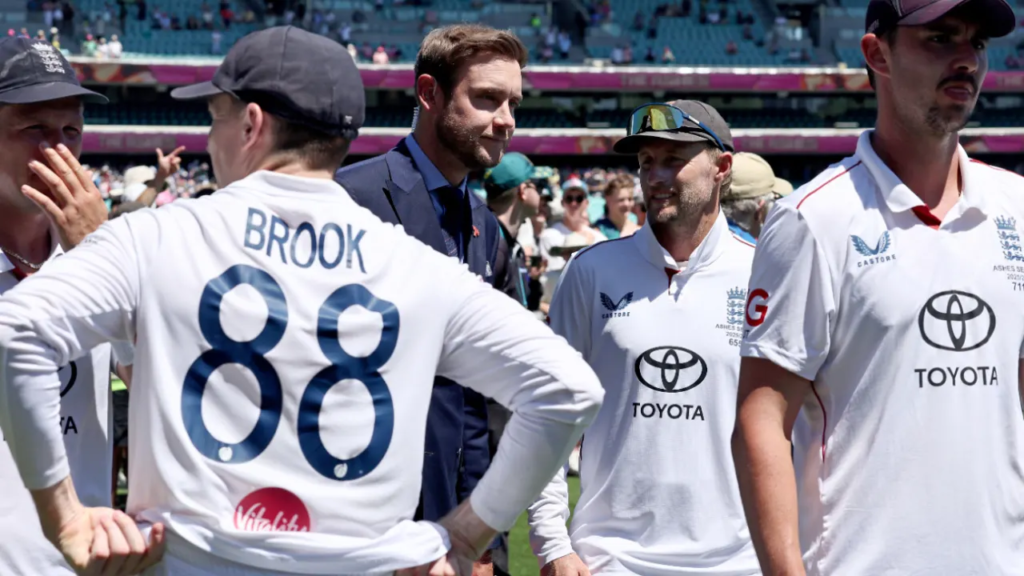
Stuart Broad defends claims of England’s alleged ‘drinking culture’ but admits they could have done more to avoid controversy.
Former England seamer Stuart Broad maintains that the current Test team does not have a drinking issue, but he acknowledges that the players should have done more to prevent the bad press that followed their 4-1 Ashes loss.
The 39-year-old Broad, who took 67 wickets at 26.67 in 15 games before and included the 2023 Ashes, was a key player in the early years of England’s so-called “Bazball” era. During this winter’s tour of Australia, he has stayed close to the team as a key media presence after retiring following that summer’s series-squaring victory at The Oval.
Harry Brook apologised after news surfaced of his incident with a nightclub bouncer in New Zealand, which resulted in England’s Test vice-captain being fined £30,000, following England’s defeat in the fifth Test in Sydney. During the team’s mid-series break in Noosa, a number of other players were seen drinking, including Ben Duckett, who looked disoriented in the street after a night out and seemed to be slurring his speech.
The potential that England’s management will reinstate a 12 a.m. curfew for the white-ball team’s upcoming trip of Sri Lanka in advance of the T20 World Cup has been raised by these instances. However, Broad cautioned that such actions can backfire in an interview with The Love of Cricket podcast.
“They’ve just had a couple of guys who have made mistakes and that’s got into the media,” Broad said. “I think it’s up to your team-mates to get you out of those situations, and that’s when your culture’s really strong.
“Ben Duckett isn’t left alone, no idea where his hotel is. Harry Brook doesn’t get himself in a situation with a bouncer, because they’re not allowed anywhere near that situation. So I think that’s the thing that will disappoint Baz [head coach Brendon McCullum].
“I really didn’t like having a 12 o’clock curfew, because I just didn’t feel like you should need it. As long as you have people around you to get yourself home at a suitable hour, having the team-mates around you to go,’ your time’s up’.”
“As an international player, you need some sort of release,” he said. “I’m not saying it’s ‘have a few beers, whatever your release is’, but if you don’t have that mental switch-off, it drives you mad if you don’t do anything.
“Cricketers are away six months of the year in hotels. [But] there isn’t a drinking culture. I’ll hang my hat on that, knowing the boys as well as I do. But it is just making sure the boys don’t get in trouble when situations arise.”