

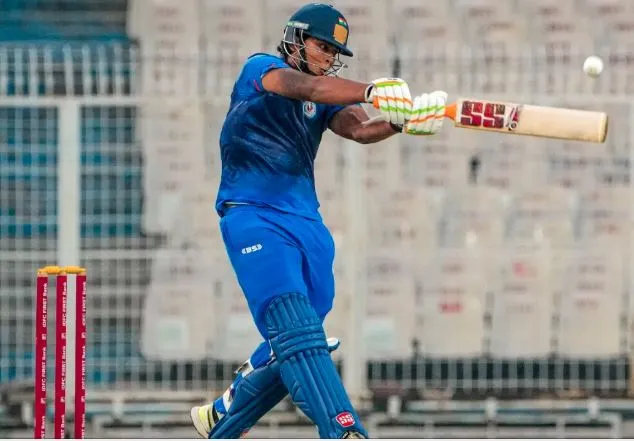
The 2025–26 Syed Mushtaq Ali Trophy has quietly turned into India’s most important T20 talent crèche, happening alongside global franchise sprints and Test marathons. This season’s loudest domestic punctuation came from 13-year-old batting prodigy Vaibhav Suryavanshi, who dismantled Maharashtra with a thunderous 108* — a coming-of-age moment that double-checks India’s future-facing T20 hypothesis: power doesn’t mean randomness. Power means timing clarity inside chaos windows. If India wants generational format depth, they need players cut from a different mental fibre, not just a different shot arc. Suryavanshi didnicated both.
To understand the magnitude of this knock, you must frame the league environment first. SMAT is India’s primary pathway to IPL rosters, international white-ball fringes, and U19 elevation into senior radar. With group stages running at high churn, every match is a mini-audit of survival skills, role honesty, strike geometry, and fatigue elasticity. India’s T20 game globally has long thrived on fast failure correction — stand up, self-iterate, and go again. Domestic cricket is now being coded to extract that trait explicitly. And Suryavanshi’s hundred showcased precisely the qualities selectors want to bottle for the post-2026 era.
His innings was everything T20 “violence” is misunderstood to be — but anchored in judgement, not hysteria. He scored fast not by gambling rhythm, but by decoding risk clusters: attack early in overs when fielders can’t settle geometry, respect anything with behaviour-group power, exploit anything leaked mid-corridor. The fact he finished 108* instead of 108 (74) tells you he already owns two cardinal T20 truths that most hitters take years to learn: (1) stay long enough to ruin opponent plans, and (2) don’t swing yourself into lower-order salvage jobs. That kind of innings solvency ends careers for bowlers, not for lineups.
What also stood out was strike modulation. Every young batter who hits big in T20s is assumed to be a ball-hacker. Vaibhav is different. His assault came with premeditated positioning. He didn’t chase boundaries — he created them mid-over when bowling angles lost margin value. He didnnulated overs in blocks, treating 120 balls like solvable equations in recurrent 4-over segments. This is a skill Rohit Sharma and Virat Kohli mastered for 50-overs; the next generation must master it for 6-over pockets. When a teen can score 108* and still look mentally unfrayed, that’s not a highlight — that’s a hiring signal.
SMAT also shows why India keeps producing future T20 captains from domestic first-class compost heaps like the Ranji system — temperament over temper. Even if a T10 league rewards grenades, SMAT rewards gradients — pressure applied in ramps, not cliffs. Bowlers who “hold firm” like Maharashtra did early are exactly the bowlers who benefit from this tournament; they get to bowl four-over bands that escalate variance control, discipline over outcome latency, and induce mistakes through tempo suffocation rather than speed worship.
Suryavanshi’s hundred also erupted from within the India domestic system’s future traits: not just bayonet power hitting, but match algebra mastering. A century built through partnership sequencing means you don’t make the team rely on the next man’s rescue shot. The best T20 players between 2025–2027 will belong to one archetype: impact sequencers who can hit without hyperventilating innings stability, bowlers who build pressure like a plan, and captains who throttle tempo rather than audition adrenaline.
This season is proving one durable outcome: India’s domestic T20 pipeline isn’t empty, it’s just evolving into phased intelligence extraction, where future-proof hitters like Vaibhav find their voice inside real consequence windows. A 108* isn’t just big. It’s proof he scores like a system — not a sparkler. India’s next format chapter will belong to kids who already understand mini-innings project management under T20 timelines. Vaibhav isn’t the first. He’s the prototype.
12BET Shortlisted for Sportsbook Operator of the Year at SBC Awards 2025