

Talking points from Australia’s Ashes squad selection as final choice comes down to two players from three this series.
Ashes squad talking points: Kingmaker Green to dictate Australia’s plans.
It was long anticipated that Beau Webster and Cameron Green would be selected for the team together. In Australia’s last four Test matches, the two have been in the same starting lineup. However, Green was not bowling with Marnus Labuschagne opening in one of them before Sam Konstas took Labuschagne’s place in the other three. Green was a specialist batsman at No. 3, a position he had only batted in once in first-class cricket before.
Green was undoubtedly Australia’s finest batter during the last two Test matches, which were played on extremely challenging pitches in the West Indies. However, the necessity of having two all-rounders rather than a more organised batting lineup is called into doubt now that he is bowling again.
Green’s recovery following back surgery hasn’t quite gone as planned, either. Although he has been bowling in the nets continuously since June, he has only bowled four overs in games thus far.
It is said that he has already bowled up to 8–10 overs in a single net session over several periods. In Western Australia’s upcoming Shield match against Queensland at the WACA venue beginning on November 11, Bailey indicated he would bowl 15–20 overs, or about 8–10 overs each innings. The form of the Test XI may depend on how he completes those overs and how skilfully he bowls.
Webster has also taken eight wickets at a rate of 23.25, but he has benefited from the ball on those same pitches. Even Webster’s Shield record pales in comparison to Green’s home Test record with the ball. In Australia, Green has taken 22 Test wickets at 25.63, hitting at 52.1. During the 2021–2022 Ashes series, he dismissed Ollie Pope once, Joe Root, Zak Crawley, and Ben Stokes twice apiece.
Since David Warner’s retirement, the selectors have been frantically trying to find a solution at the top of the order. Jake Weatherald will be the sixth different opener to partner Usman Khawaja in the last 15 Test matches since Warner’s retirement if Green can bowl the necessary overs and Webster is removed.
Weatherald is unquestionably the best domestic red-ball opener in Australia over the past 12 months, in contrast to the elevations of Steven Smith, Travis Head, and Labuschagne as well as the choices of Nathan McSweeney and Konstas. Since the beginning of last summer, he has amassed 1391 runs at a rate of 53.50 in 26 innings, including four hundreds and seven half-centuries for Australia A and Tasmania.
Beyond the runs, Bailey gave Weatherald’s style a lot of praise. At a quick strike rate of 68.65, he has scored runs. While Labuschagne scored at 41.47 in his final 14 Test innings prior to being dropped, Khawaja’s Test career rate is 48.56. Last summer, there were moments when the scoreboard did not move against India, which prompted Konstas to be added. However, Bailey pointed out that a major factor in Weatherald’s selection over Konstas was his consistent approach, first-rate experience, and the fact that his game does not fluctuate from innings to innings.
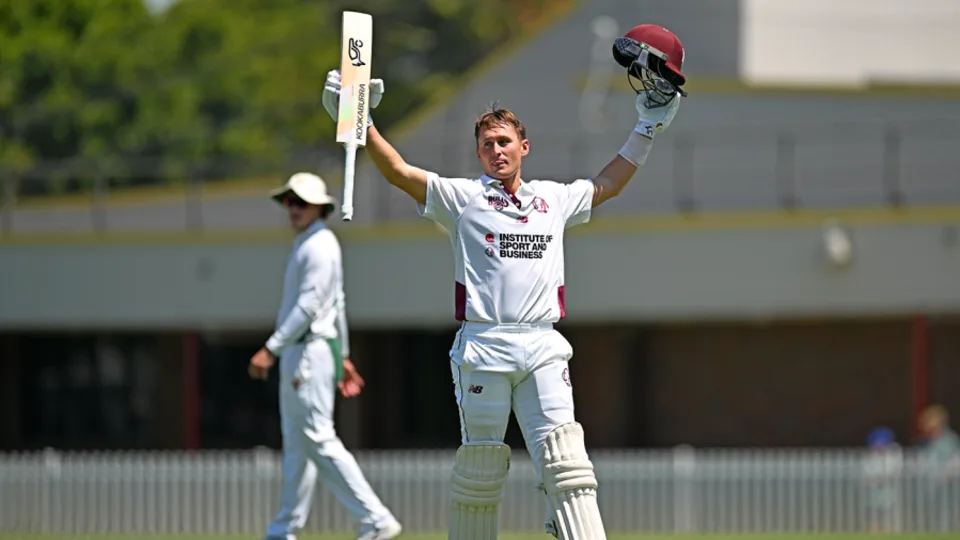
With 16 days remaining, Bailey claims that no decisions have been made regarding the starting lineup, although it seems obvious that Labuschagne will return. The selectors deliberately urged him to go away and find his best game after dismissing him in the Caribbean, so it would be absurd to leave him out following five hundreds in his last eight domestic innings for Queensland.
Where Labuschagne bats, however, will depend on the outcome of Green and Webster. He has scored all of his runs for Queensland at number three.
The biggest clue Bailey might provide about the ideal order is the question of players complimenting one another. Clearly, the selectors would prefer that Labuschagne and Khawaja do not open together. In Test matches, Labuschagne’s most successful batting partnerships have been with Warner, Smith, Head, and Matthew Wade.
The Australian team believes Labuschagne is a kind of batting chameleon because of his ability to imitate his partner’s style. Time will tell if that is still the case with the renovated Labuschagne.
However, a return of a No. 3-4-5 combination of Labuschagne, Smith, and Head will undoubtedly be more difficult for England’s offence to breach if Labuschagne is back to his best.