

A heaving stadium in Ranchi witnessed a modern 50-over contest that ran like a three-act film: a build, a bang, and a breathless ending. India national cricket team walked out first on a flat pitch buzzing with anticipation. The script for the day was clear — go big, go early, but pace it smart. And right at the heart of that script stood one man playing one of 50-over cricket’s most bankable roles.
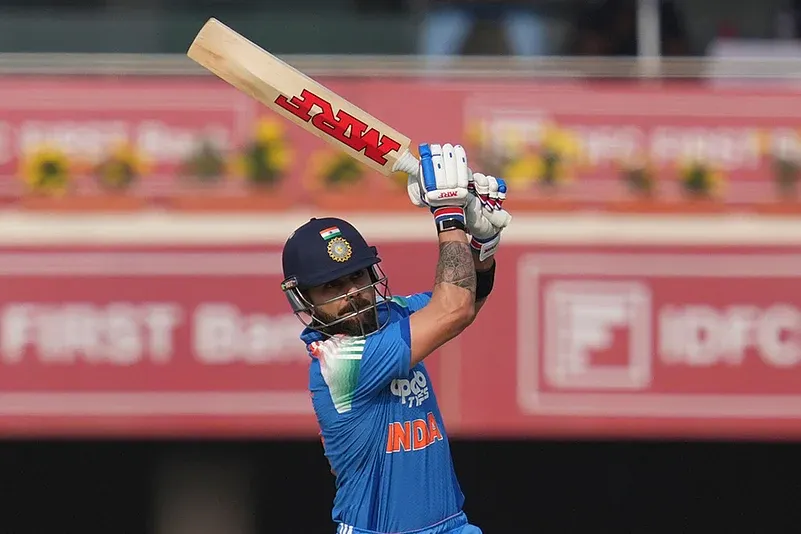
Virat Kohli produced a master-class 135 off 120 balls to notch his 52nd ODI century, steering India to a towering 349/8 against South Africa national cricket team. This was no ordinary hundred, and definitely no accidental one. It was innings architecture built on intent, patience, and lethal timing — an approach Kohli has refined over 17 years but continues to evolve to stay ahead of the format’s accelerating curve.
From ball one, South Africa set attacking fields, eyeing early movement off the surface. But the pitch had other ideas. It offered pace-friendly bounce, but minimal assistance in lateral drift. When field restrictions closed at the end of the powerplay, India had already advanced comfortably, posting 80/1 in 10 overs. Kohli had played 18 of those deliveries largely in third gear — nursery taps, rotating strikes, probing bowlers into predictable lengths.
At the other end stood India’s ODI captain, who began in full throttle. Rohit Sharma cracked 57 off 51 balls, hammering the new ball with authority, allowing Kohli the luxury of calm accumulation early on. Their 136-run second-wicket partnership was the day’s first hinge. Rohit’s aggression disorganized South Africa’s bowling plans. Kohli’s control ensured the chaos benefitted India, not the opposition.
Once Rohit fell, trapped by a slower one from Marco Jansen, Kohli clicked into his second innings persona: dominance through deterrence. He put the spinners under a microscope, charging down selectively but never gambling. Maharaj was forced deep by the threat of the loft — not always the execution of it — opening the cover and long-on pockets for India’s best batter to milk ones, twos and punish anything fractionally short.
Kohli’s 52nd ton was brought up in 103 balls with a trademark punch through extra cover to the boundary — all class, no panic. From there, the audience got what they bought tickets for. Kohli took South Africa’s fifth bowler, Lungi Ngidi, apart in the 38th over, clubbing 4-6-6-4 to swing the momentum needle violently India’s way. His acceleration was clinical surge, landing at exactly the stage where batting rhythm meets scoreboard impact.
But even Kohli knew a 135 must wear body armor, not ballet shoes. He farmed the strike against the second-string bowlers, protecting the middle order for later thrusts. KL Rahul provided a 60-run resident support act, while Shreyas Iyer delivered a sharp 36 off 27 balls to keep India’s boundary frequency high through overs 30–40.
The final 10 overs, where most teams historically explode, saw India stack smart, not sloppy. Axar Patel and Washington Sundar didn’t go berzerk — they ensured the total crossed from “big” to “uncomfortably big.” Their combined 52-run addition in overs 45–50 gave India 349 — a number every bowler would nod at before being asked to defend at night.
South Africa tried to rewrite the chase later. But in the sunlit innings that defined the day’s foundation, it was Kohli who penned the first 50-over truth of this contest: in modern ODI cricket, totals aren’t mountains — they’re launchpads. And Kohli showed exactly how to launch without losing your shape, your wickets, or your mind.
12BET Shortlisted for Sportsbook Operator of the Year at SBC Awards 2025