

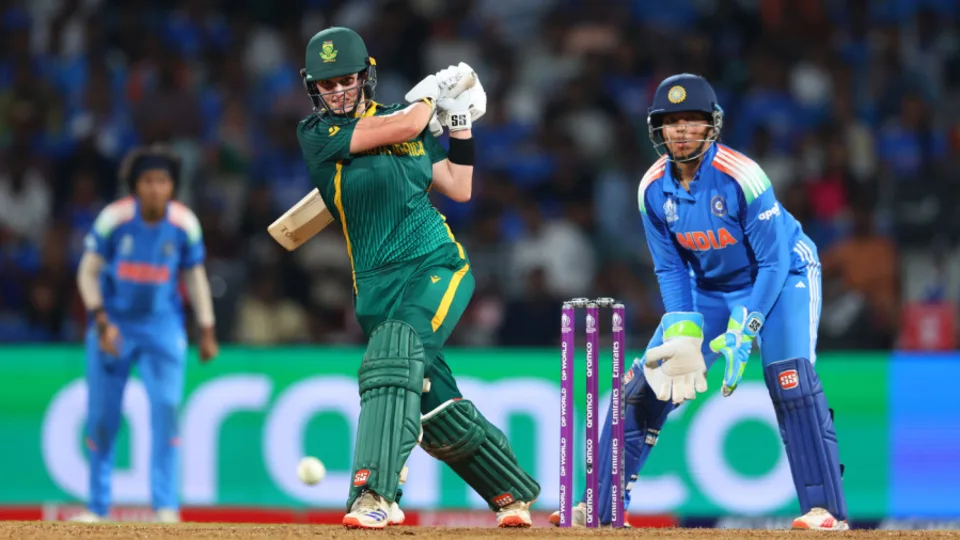
Wonder Wolwaardt shows next phase of her batting brilliance as she broke records and added layers of aggression with the bat.
Wonder Wolvaardt takes her ODI game to a higher plane with masterful batting and World Cup for the record books.
If you were unaware of Laura Wolvaardt’s uniqueness, you may learn about it via this brilliant South African TV commercial. In August 2016, Wolvaardt broke Quinton de Kock’s record from November 2013, when he was 20 years and 326 days old, by hitting a hundred against Ireland at the age of 17 years and 105 days.
She started off as a high achiever as a teenage prodigy who was also a straight-A student, a future doctor, and an occasional musician. Because her batting was so visually appealing, two hundreds in the first 15 months of her ODI career portended great things. Comparisons with Aiden Markram’s cover drive were supposed to praise Markram, not the other way around.
She batted too slowly at one point, with a strike rate of less than 60 in her maiden year of ODIs and about 70 until the 2022 World Cup, but she played a lot of T20 cricket and became better. By the time she was named captain following the 2023 T20 World Cup, only Wolvaardt was worried about her ability to balance that position with her batting. She quickly provided a response to her own query regarding her competence.
In just two years, Wolvaardt had scored six hundreds, including one in her seventh innings as captain. Wolvaardt had a strike-rate of 122.30 as captain prior to this World Cup, averaging 56.40 in ODIs and 40.37 in T20Is.
Nevertheless, her game lacked certain elements. Although Wolvaardt could find holes on the ground, she rarely got over the top and continued to be primarily an off-side player. She had actually only struck 11 sixes in 110 ODIs before to the 2025 Women’s World Cup.
She thought that her ODI performance suffered in 2025, scoring 100 in eight games while Tazmin Brits, her opening partner, scored five. And then, the World Cup started slowly for her with scores of 5 and 14 against England and New Zealand before she started to get going.
A 70 against India set South Africa up for a winning chase, while scores of 60 not out and 90 against Sri Lanka and Pakistan could easily have been much more. Wolvaardt scored those runs in 47 balls, and her most effective shot was the on-drive, but her innings against Sri Lanka only ended because South Africa’s target was reached. Things were shifting.
The two games of her life followed. In the semi-final match against England, Wolvaardt scored 169, revealing a completely different side of herself. She smashed sixes over midwicket—four in the innings, to be exact—and showed a power-hitting quality that had never been seen in her before. Her heroic 101 came off 98 balls in the final, with a strike-rate of over 100.
Rather, it is unique to Wolvaardt. In a single ODI World Cup, she has scored more runs than any other player. Although she was previously South Africa’s top ODI run scorer, she now stands sixth on the all-time list after reaching the 5000 run milestone in this tournament. Given that she is probably going to play longer than Smriti Mandhana, who is three years older, the sensible money would be on her to win at this rate.
Lea Tahuhu, an early contender for catch of the tournament, was dismissed by her one-handed stunner at extra cover, one of the most outrageous catches she made during the tournament. Wolvaardt demonstrated through statistics and deeds such as the aforementioned that she is both a dynamic athlete and a shrewd professional, but that there is genuine heart behind both traits.
When South Africa lost the T20 World Cup final last year, she didn’t show any emotion at all. However, when they lost the final in Navi Mumbai, she did show some tears and a few sad smiles. However, she didn’t break like many of her teammates.
Whether that is a front from someone who wants to put on a brave front, or the true and mature knowledge of someone who is aware the world has not ended because a match was lost, is still unknown. It’s simply leadership for South Africa, and it’s the kind that might be essential to keeping this team cohesive.
Mashimbyi is not the only one who thinks South Africa will return because the country’s success in all sports is ingrained in its DNA. However, there is also weariness. It is exhausting to make it to final after final and end up empty-handed, and there may be a perception that South African cricket is turning into the sport that screams wolf.